


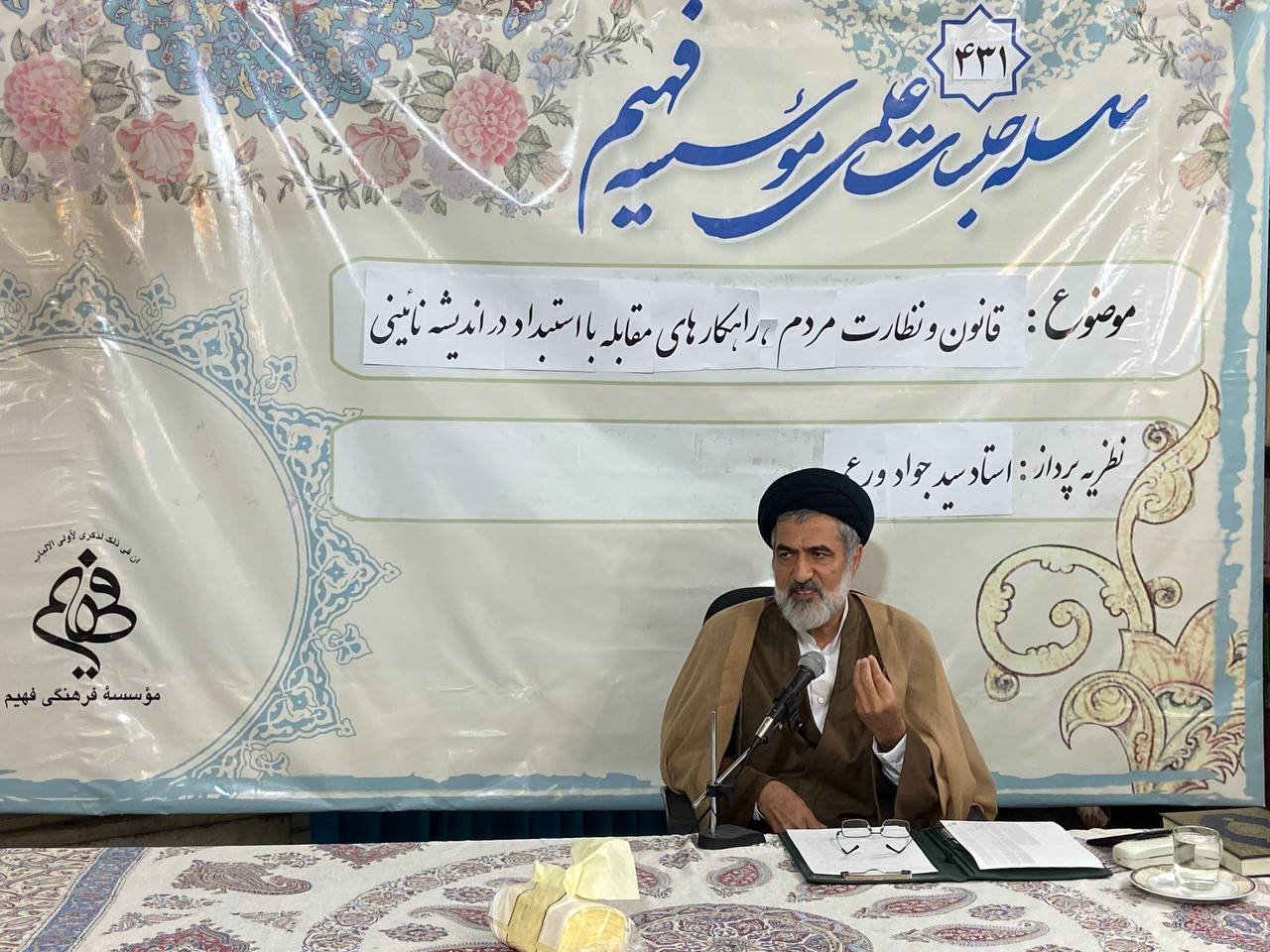
بسم الله الرّحمن الرّحيم
الحمدُ للهِ رَبِّ العالمينَ وَ صَلَّى اللهُ عَلَى سَيِّدِنا وَ نَبيِّنا وَ حَبيبِ قُلوبِنا أَبِي القاسِمِ مُحَمَّدٍ (صَلَّى اللهُ عَلَيْهِ وَ آلِهِ وَ سَلَّمَ) وَ عَلَى أَهْلِ بَيْتِهِ الطَّيِّبينَ الطّاهِرينَ.
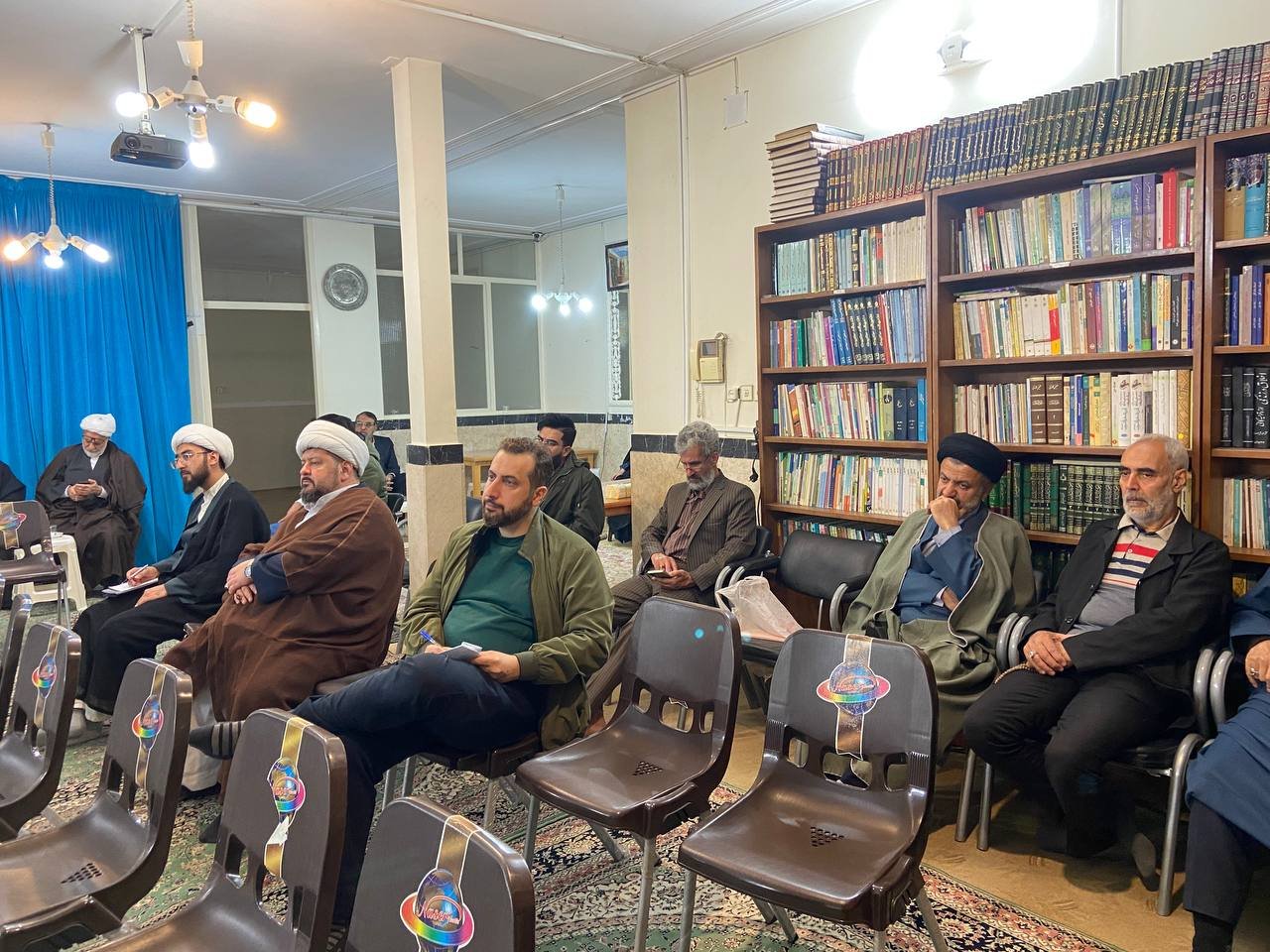
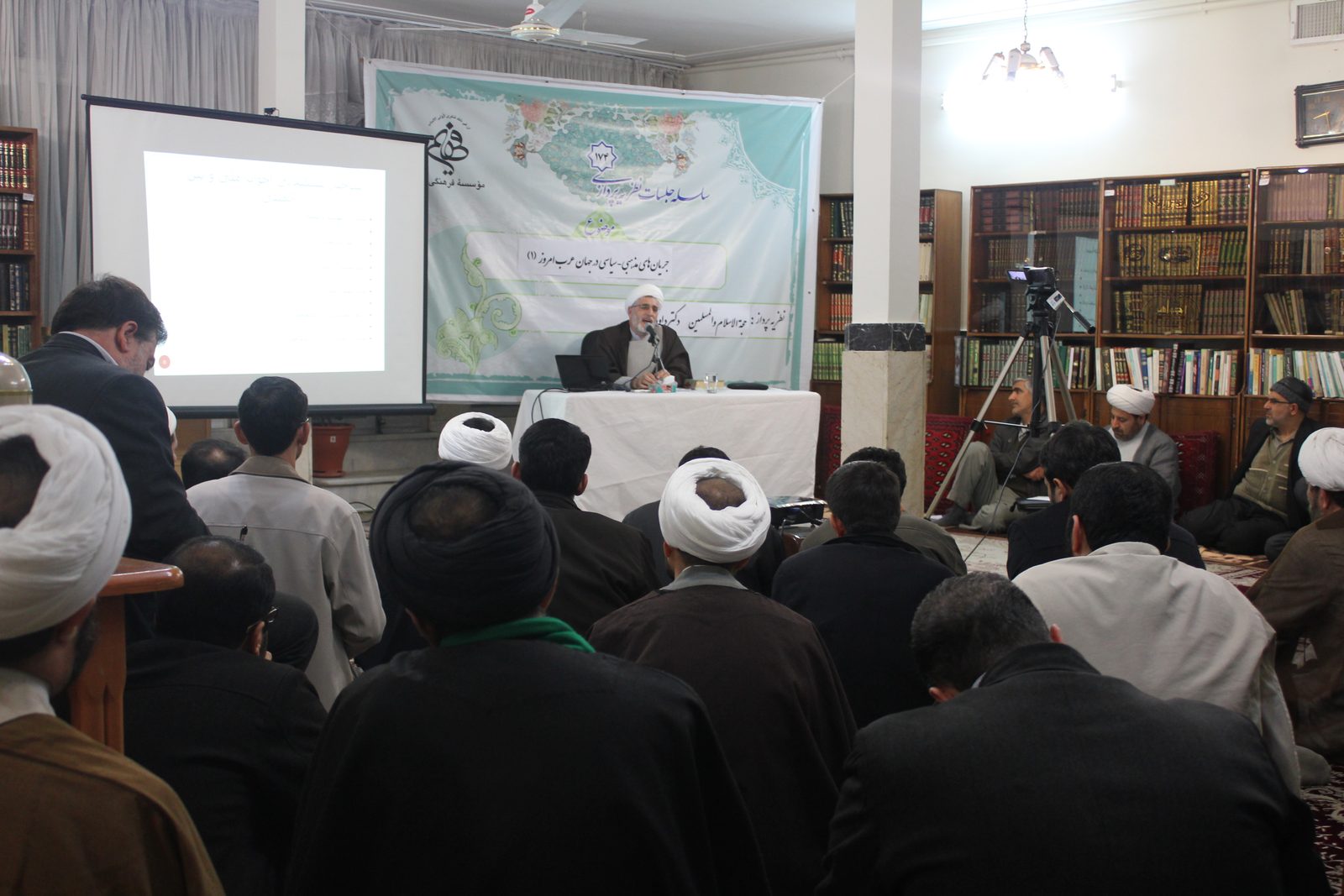
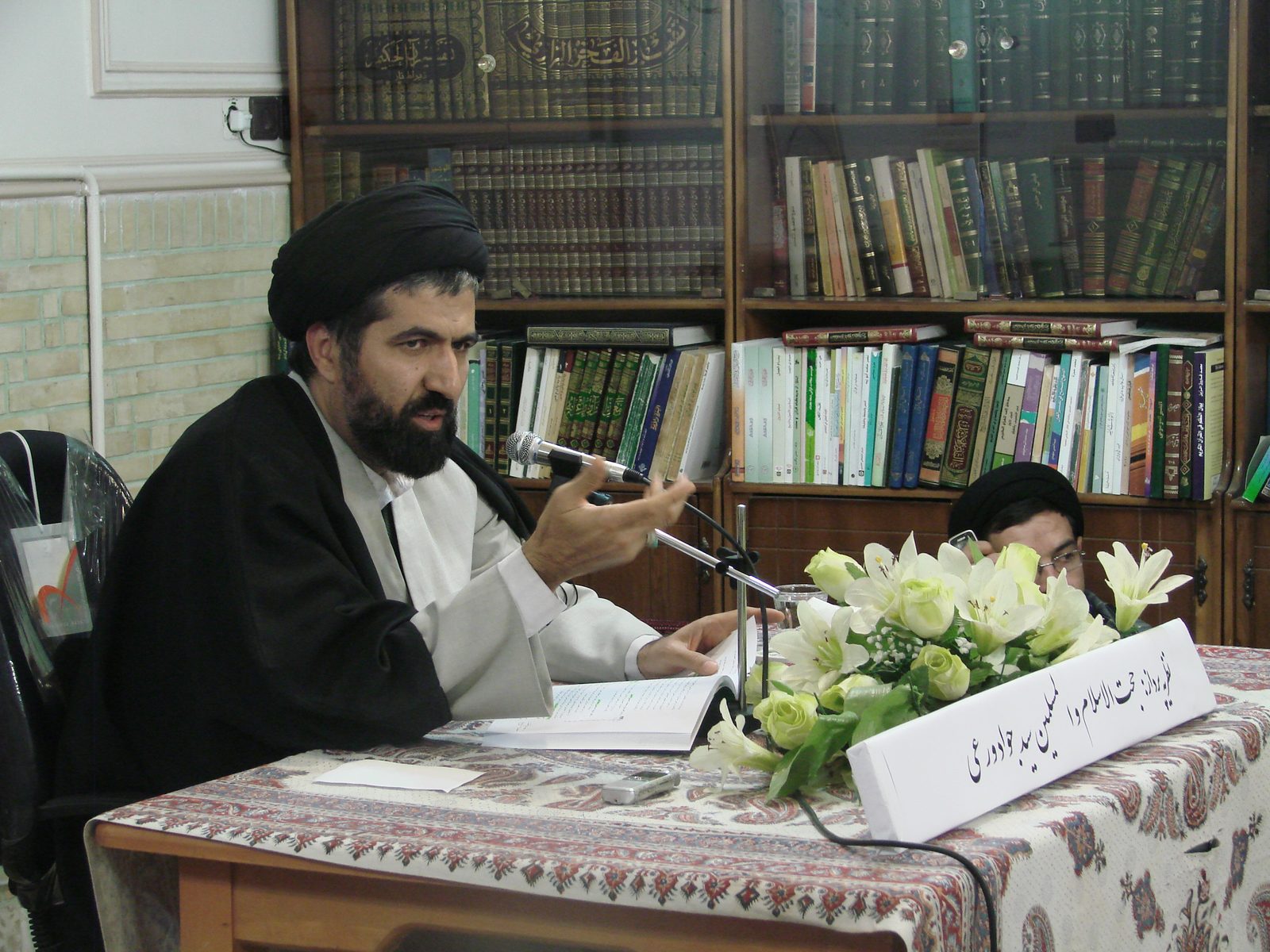
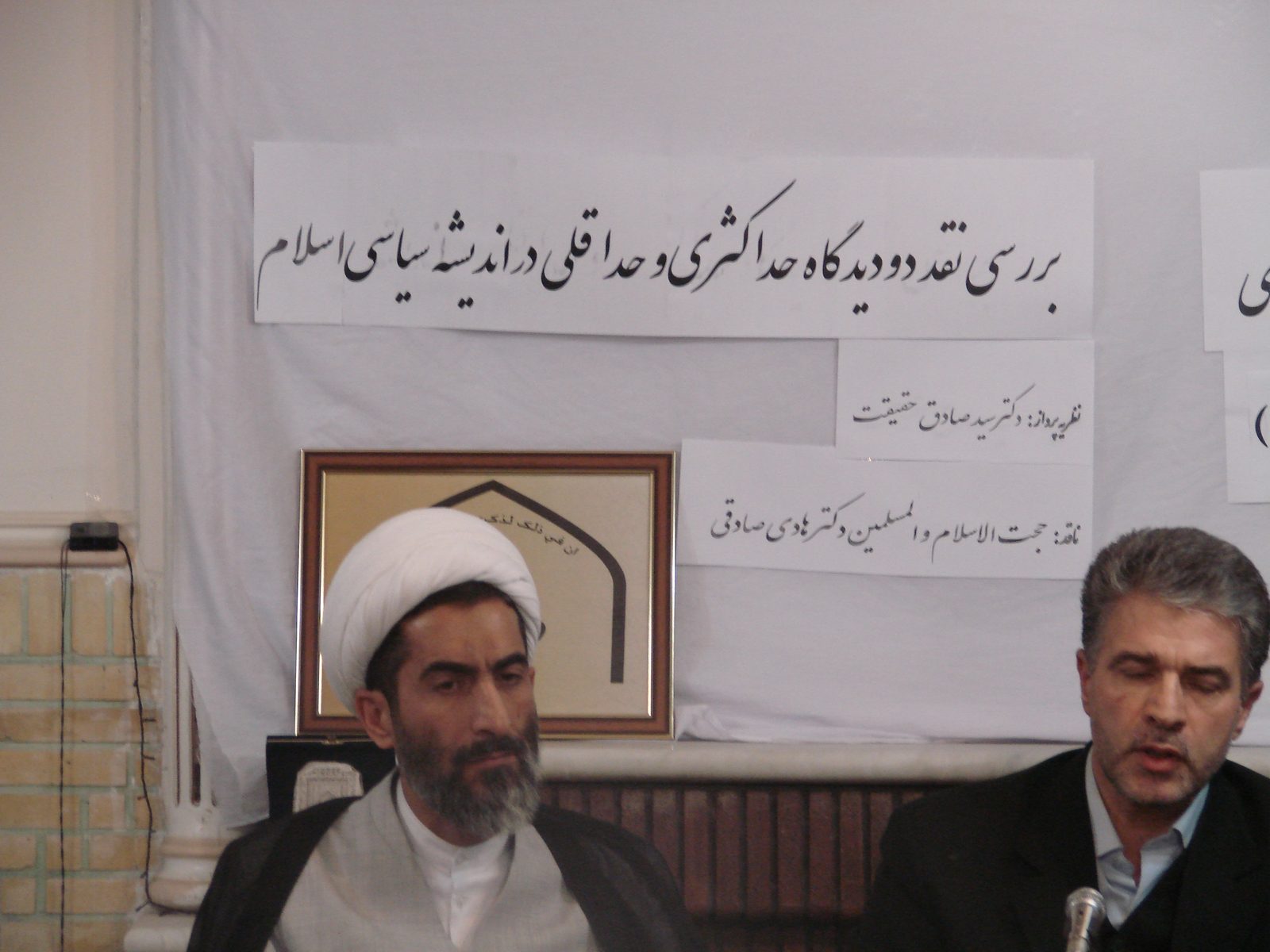
First of all, I am grateful to the esteemed Fahim Institute for providing this opportunity to speak for a few minutes about the political thought of Allamah Na'ini, and I apologise in advance to the honourable professors who have graced this session with their presence for the trouble I am about to cause them.
It occurred to me—given the atmosphere that has arisen these days on account of the conference commemorating Allamah Na'ini held in Qom and Mashhad, whose second part is also scheduled to be held in the cities of Najaf and Karbala, and one of whose achievements is the publication of the collected works of Allamah Na'ini—to raise a question befitting the holding of this conference. For in these days, owing to the opportunity that has arisen, a matter has been raised in interviews, lectures and some articles upon which, in my view, it would not be amiss to reflect; namely, whether there was a serious disagreement between Allamah Na'ini and the late Sheikh Fazlullah Nuri—and, more generally, between the ulama who defended constitutionalism and the ulama who opposed it (or, more precisely, the advocates of mashru'a constitutionalism, that is, constitutionalism conforming to the Shari'a)—or not.
For what is being said and written, especially in these days, is that there was no great disagreement; [as if] the ulama were opposed to an English-style constitutionalism, opposed to the constitutionalism that Westernised intellectuals were advancing, and their disagreement concerned the instances [of application]; otherwise, they had no serious ijtihadi difference of opinion.
Although this claim can be accepted with regard to some issues—with regard to certain disputed issues, yes, the disagreement may well have concerned the instances. For example, regarding the principle of equality or the principle of liberty, the view and judgement of each side was directed at a particular definition of equality or liberty to which the other side's view was not directed, the latter having a different understanding of these two pillars that were counted as the foundations of constitutionalism.
But the truth is that, with regard to certain issues, there was a serious difference of opinion. And I believe that the ulama of Najaf—the late Akhund, the late Mazandarani and the late Na'ini in this valuable book, "Tanbih al-Umma wa Tanzih al-Milla"—correctly recognised the necessities of their own time, and on the basis of what they discerned to be the necessity of their time, entered the arena of constitutionalism and of its defence. In this respect, had the ulama opposed to constitutionalism, or the advocates of mashru'a constitutionalism, perhaps joined hands with the ulama of Najaf, had a unity of word formed among the ulama, and had a faction of the ulama not stood alongside Muhammad Ali Shah Qajar, constitutionalism might perhaps have met a different fate. For certain political opportunists exploited the difference of opinion among the ulama: first they removed the ulama opposed to constitutionalism from the scene, then the ulama who defended it, and there came about what all of you, distinguished as you are, know.
My view is that the ulama who stood in opposition to the first-rank marja's of Najaf and to the ulama who defended constitutionalism did not correctly recognise the necessity of their time. Although with regard to some issues their views were correct, [and] with regard to some of the individuals who dominated the constitutional arena [their judgement] was right, yet, taken as a whole, the necessity of the time demanded that the despotic Qajar system in Iran be dismantled, and this was not possible unless everyone joined hands and carried the work forward with unity of word.
The late Na'ini believed that, in general, what had caused the backwardness of the Islamic nations was despotism. The principal concern of the ulama of Najaf, and specifically of the late Na'ini—which caused them grave anxiety and was precisely what led them to enter the arena of defending constitutionalism—was the problem of despotism: in the first stage, political despotism, and in the later stages, the joining of religious despotism to political despotism. They believed that the causes of the Muslims' backwardness were their affliction with despotism and their affliction with the oppression of the despotic governments that had ruled over them throughout history. Conversely, they attributed the growth and progress of the other nations of the world, especially the Europeans, to the fact that they had recognised this malady in their own time, had risen up to confront it, had overthrown despotic governments under the banner of liberty, and had established new models of government in their own countries; because despotism is an obstacle to the growth and progress of any nation in its various spheres.
Indeed, he begins the book Tanbih al-Umma from precisely this point: that the nations of Europe recognised that principal malady. And he believes, of course, that after the Renaissance and after the Crusades they drew this inspiration from our religious teachings—the question of liberty, the question of equality, the negation of despotism. Hence he uses the expression: «ضَاعَتْ بِضَاعَتُنَا وَ رُدَّتْ إِلَيْنَا» (Our merchandise had been lost and [now] has been returned to us). So what is it that you are opposing? These things—what is put forward under the banner of constitutionalism—are rooted in our religious teachings.
Well, in fact the late Na'ini, since he regarded despotism as the common malady of the Islamic Ummah, expressed astonishment that the followers of the Sunni school had acted before us and had welcomed the wave of constitutionalism and liberty, whereas we—although we ought to have been the vanguard in this field—had fallen behind. And he reproaches the ulama opposed to constitutionalism. In truth, [he wrote] this book to expound that the essence of despotism is none other than shirk, none other than the negation of tawhid. His message in this book is that despotism is, in its very essence, shirk and a stand against divine oneness, against tawhid.
The late Martyr Motahhari (may God be pleased with him) has a statement about this book, and the martyred Professor Motahhari's judgement about this book is indeed accurate. He says: "In fairness, no one has expounded the precise interpretation of the practical, social and political tawhid of Islam, together with sound arguments and citations from the Qur'an and Nahj al-Balagha, as well as the great Allamah and towering mujtahid Mirza Muhammad Husayn Na'ini (may his soul be sanctified) has done in the precious book Tanbih al-Umma wa Tanzih al-Milla." Martyr Motahhari's understanding of this book—that is, his view of this book—is this: the book in fact delineates the social tawhid of Islam, and regards the gravest calamity of the Islamic Ummah as its entanglement with, and contamination by, shirk—social shirk.
Well, again by way of introduction, I should note that the late Na'ini wrote this book during the period of the Minor Tyranny. That is, if we pay attention to the period in which this book was written, we will see who its addressee is, which current they are, and, in truth, whom this book was written to refute and to which juncture of history it relates. As you know, after Muzaffar al-Din Shah issued the constitutional decree, the National Consultative Assembly was formed and the Fundamental Law was written; at the insistence of Sheikh Fazlullah Nuri and some of the ulama, the second article of the Supplementary Fundamental Law was added to it, and the supervision of the first-rank mujtahids was in some form included in the constitution (that is, in the Supplement to the constitution). When power passed to Muhammad Ali Shah, he opposed constitutionalism. And with the support of the ulama opposed to constitutionalism—[that is,] the ulama who advocated mashru'a—they in fact once again, that is, this time, suppressed the constitutionalists and, with Russian support, bombarded the National Consultative Assembly with artillery.
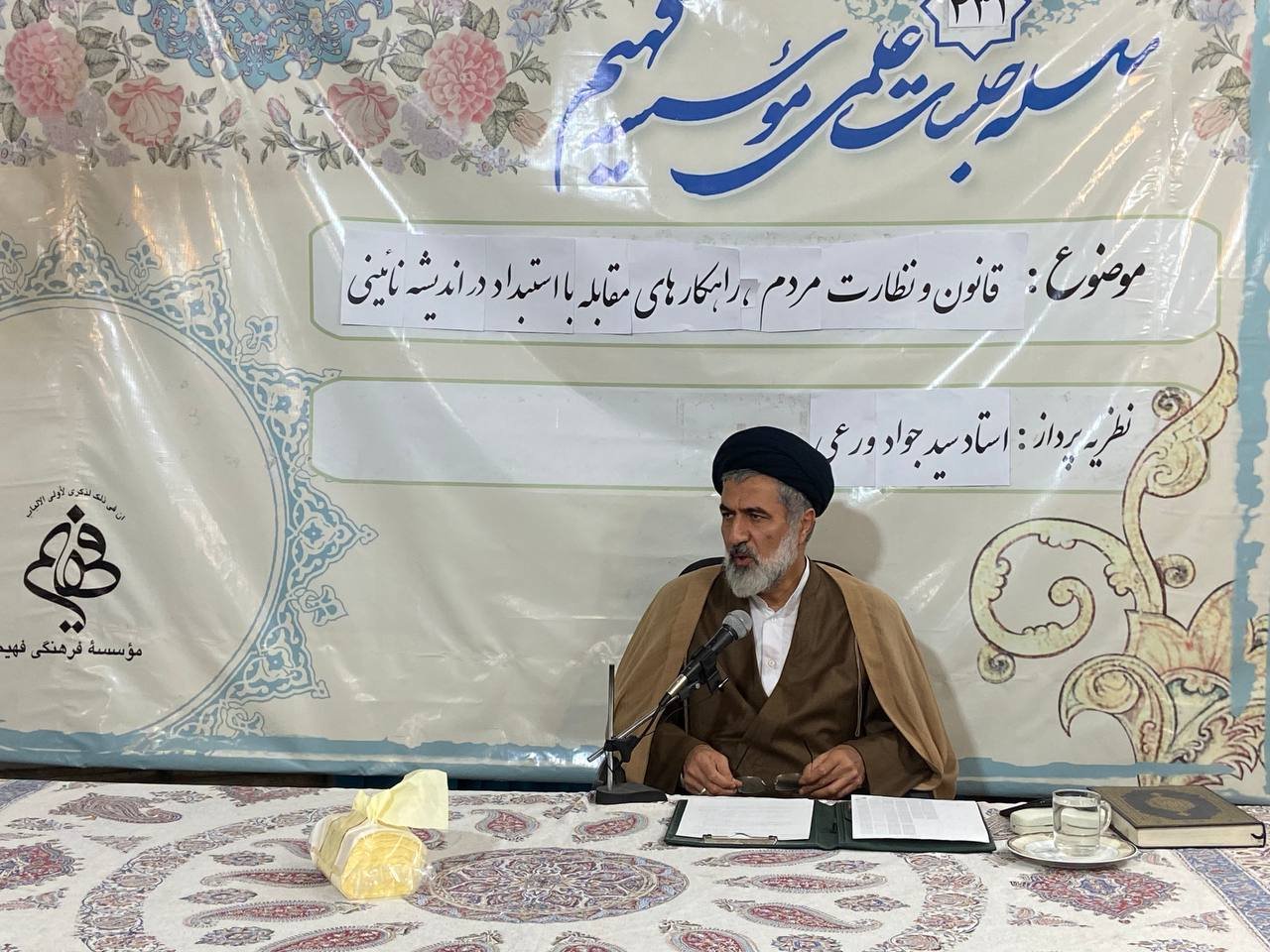
And they wrote tracts and treatises: the treatise "The Prohibition of Constitutionalism", the treatise "Tadhkirat al-Ghafil", and various other treatises written by the ulama to prove that constitutionalism was forbidden. They even sent some of these to Najaf. And these treatises written by the ulama on the prohibition of constitutionalism became the motive for the late Na'ini to write Tanbih al-Umma, and indeed to devote an entire chapter of this book to answering the objections of the ulama opposed to constitutionalism. Therefore, this book was written in this atmosphere.
It is true that when it was published, its publication coincided with the renewed victory of the constitutionalists and the hanging of Sheikh Fazlullah Nuri; its publication coincided with the victory of the constitutionalists, who, in the words of some constitutionalists such as Sayyid Hasan Taqizadeh and others, ran riot this time. When they conquered Tehran, they very much... Now, in the words of this man, who was himself one of the radicals of his time, he says the constitutionalists ran riot; that is, they did certain things that were indefensible, among them this very hanging of Sheikh Fazlullah.
Well, since this book was written in such an atmosphere and it is clear who its addressees are, if we wish to understand this book correctly, to know its author's motive and to know whom it was written to refute, we would no longer claim that this book was written in order to say that the constitutionalism we speak of is not the constitutionalism of which the Europeans speak, the constitutionalism of which the Westernised intellectuals speak. Yes, the constitutionalism advocated by the ulama of Najaf was entirely distinct from the constitutionalism that they—some of them—were propagating, [those who] said that constitutionalism was incompatible with Shi'ism, incompatible with Islam; they said such things too. But this book was written to refute the ulama opposed to constitutionalism and pertains to this historical juncture.
Now, parenthetically, it would not be amiss to mention that in this collection published through the efforts of the congress, [namely] the collected works of Na'ini, one volume is this very Tanbih al-Umma. They have reprinted Tanbih al-Umma. Of course, some of the late Na'ini's descendants—distinguished persons who are present here—maintain that Na'ini's original version, [that is,] the original version of Tanbih al-Umma, was published, after which he himself made certain revisions, certain changes and certain corrections; and they have in fact printed that corrected version, and have also given in the footnotes its differences from that first printing—[that is,] from the original version that had been published, which is the Tanbih al-Umma available to us now. Certain changes, verbal changes of course, relatively numerous changes, can be seen. I have, of course, looked through it, but have not yet had the opportunity to examine these cases in detail. [But] no great change arises in the message of the book; some verbal changes and expressions... For example—well, after one hundred and twenty years, a book that has been published and gone through numerous printings, and now suddenly a corrected version is published—this too is somewhat unexpected. That is, one would have expected that, if such a work existed, it would have been made available much earlier than this.
Now, my point concerns the introduction written for this Tanbih al-Umma. In that introduction, it is as though the addressees of this book were not the ulama opposed to constitutionalism at all; «كَأَنْ لَمْ يَكُنْ شَيْئًا مَذْكُورًا» (as though it had not been a thing worthy of mention). I will quote for you a passage from the introduction to this book, in which there is no reference whatsoever to the atmosphere in which, after all, this book was written, or to whose objections it was written to refute; there is nothing of the kind at all.
He [the author of the introduction] has written: "When he [that is, the late Na'ini] sees that the enemy, having been brought to its knees and driven back, has turned to casting doubt upon the very principle of constitutionalism and its principles (liberty and equality), presenting these principles as incompatible with Islam, he sees the remedy in writing and publishing material in defence of constitutionalism, to clarify the position of the constitutionalist ulama and to awaken the nation to the necessities of the sacred Shari'a. Through resolve and perseverance he succeeds in accomplishing this great task and writes a book entitled Tanbih al-Umma wa Tanzih al-Milla, in which he learnedly reconciles the principles of constitutionalism with the Book and the Sunna, by the method and style of fiqh, answers the objections precisely, and forever puts an end to unseemly talk and misplaced cavilling. In this work he made it understood that what the Westernised say and pursue is not the aim of the ulama: liberty is not licentiousness and release from every restraint; equality is not the sameness of all creeds and of all divine and human laws; legislation is not innovation in religion and the introduction of laws incompatible with religion. This precise and learned defence of constitutionalism dispelled many doubts and was a mighty jihad in those days, when diverse interpretations of constitutionalism were being offered and every newly arrived group and faction strove to interpret it according to its own idea and view and to steer the movement in the direction it desired."
There is no reference [made] to the fact that, after all, those who raised these objections were a broad spectrum of ulama, that it was specifically Sheikh Fazlullah Nuri who had raised these objections, and that Na'ini set out to answer them. In any case, it seems the atmosphere now is such that... I do not mean to say that fanning the disagreement that existed among the ulama is, say, a positive thing; but it is a reality that existed in the history of the Constitutional Revolution, and an instructive one too: a severe disagreement, some of the expressions of which, as used by the late Na'ini in this book, I will read to you later in the discussion. See with what language ulama reacted towards another faction of ulama, because the latter had issued a fatwa declaring constitutionalism forbidden, had stood alongside Muhammad Ali Shah and were supporting him, encouraging him to suppress the constitutionalists, [saying] that constitutionalism must be dismantled and that constitutionalism is contrary to Islam.
Now it would not be amiss here to [relate] a memory as well, for variety's sake, so that our friends do not grow weary. In the early 1370s, I remember, a conference was held in the town of Nur in honour of Sheikh Fazlullah Nuri. Well, I attended that conference; there were university professors and there were ulama—both groups were present. One of those who has worked on Na'ini and wrote the book "Shi'ism and Constitutionalism in Iran" was also among the speakers. He was alive at that time—Dr Abdolhadi Ha'iri. There he said something about Sheikh Fazlullah Nuri; he said that for the moment we cannot express an opinion about him; the documents of the Russian embassy must be published, and then it will become clear what connections these people had with one another—whether, for instance, there were connections from there that went beyond, say, outward support.
Well, saying this—and at that conference, no less, a conference that had been organised there by its organisers (who included the Nateq Nuri brothers) to honour Sheikh Fazlullah Nuri—was hard for the ulama present at that session to bear. Some ulama who had not been due to speak were added to the speakers, and some speakers were removed. Among the things that... that is, in his lecture Mr Ha'iri read out, with great flourish, the supplications that Sheikh Fazlullah had offered for Muhammad Ali Shah. You have surely seen that in some of Sheikh Fazlullah Nuri's writings he offered very lengthy supplications for Muhammad Ali Shah. Well, perhaps at that time it was also customary, to some extent, to use such expressions. Then one of the ulama was given the responsibility of answering these remarks at that session. When he came and spoke, he said: "They had every right to be suspicious of a constitutionalism whose defenders were people like, say, Dehkhoda, with that outward appearance of theirs. And as for these supplications that you read here with such flourish, firstly, it is not certain that Sheikh Fazlullah Nuri intended them as a genuine invocation, and secondly, it is not certain that he offered the supplication with the flourish with which you read it!" That is, when ulama want to defend, they sometimes also [set about] justifying in this way... This memory is not bad either; it occurred to me here, so I related it to you. That atmosphere was also very hard for the ulama there to bear, that someone... especially in that atmosphere of the early years of the Revolution, when Sheikh Fazlullah Nuri was more prominent than Na'ini and Akhund Khurasani.
As I said, since the late Na'ini wrote this book in the atmosphere prevailing in Iran during the Minor Tyranny, his language towards the ulama is very harsh; for they saw that constitutionalism [and] all the efforts had gone to waste, that despotism had once again taken hold, and that a faction of the ulama had come to stand alongside Muhammad Ali Shah Qajar and were supporting him—and supporting him in the name of religion, no less. I would like to quote here, for you esteemed professors and dear friends, some passages from Tanbih al-Umma, so that it becomes clear in what atmosphere this book was written, against whom it was written, and in reply to the objections of which group and which faction it was in fact written and published.
He writes—after referring to the issuance of the rulings of the ulama of Najaf in defence of constitutionalism—he says: "But the pack of man-eating wolves of Iran, since they found no better means and pretext than the name of protecting religion for preserving the evil tree of oppression and despotism and for laying claim to the necks and properties of the Muslims, therefore, following the accursed Pharaonic practice that said «أَخَافُ أَنْ يُبَدِّلَ دِينَكُمْ» (I fear that he will change your religion), did not desist [?] from this name without substance and this word devoid of meaning, joined hands with the Pharaohs of Iran, and did what they did. They renewed the atrocities of the age of Zahhak and Genghis and called it piety. And they deemed it incompatible with being Islamic to strip tyrants of «فَعَّالِيَّةِ مَا يَشَاءُ» (doing whatever he wills), «حَاكِمِيَّةِ مَا يُرِيدُ» (ruling as he wishes), «عَدَمِ الْمَسْئُولِيَّةِ عَمَّا يَفْعَلُ» (not being answerable for what he does), and the like among the exclusive attributes of God. And they had no qualms whatsoever about staining the ancient Law with such a blot of disgrace and immense shame. They proclaimed it in the assembly of fault-finding Christians, and despotically inflicted such injustice upon the sacred precinct of the Seal of Prophethood itself, and indeed upon the most holy Essence of the One God. They brought the degree of oppression and despotism to this extreme, and made injustice to the Creator a means of injustice to the creation."
This language—addressed, no less, to a faction of ulama who, in defence of Muhammad Ali Shah and in opposition to constitutionalism, because they had issued a fatwa of prohibition... All this shows that the atmosphere between the two sides was a very heated one. The advocates of mashru'a constitutionalism also have harsh expressions, but perhaps [not] as harsh [as these].
Another instance he has on page 108: "Glory be to God! The intensity of immersion [that is, insistence and obstinacy], the intensity of immersion in pursuing self-interest, and the tale of «أَخْلَدَ إِلَى الْأَرْضِ وَاتَّبَعَ هَوَاهُ» (he clung to the earth and followed his own desire), bring a person to such a point that, with the aim of nullifying the limitation of domination and demolishing the foundation of the tyrants' accountability for their arbitrary acts against the lives, honour and properties of the Muslims, he weaves together such absurdities; revives anew [?] the baseless doubts of the ignorant Akhbaris; and, «مِنْ حَيْثُ لَا يَشْعُرُ» (without being aware of it), brings to ruin the foundation of the Muslims' religion and the fruit of the labours of the guardians of the clear religion, especially the renewers of the thirteenth century. «فَاعْتَبِرُوا يَا أُولِي الْأَبْصَارِ» (So take heed, O you who have eyes)! Was the true nature of legislation and innovation, with such complete clarity and self-evidence, unknown?"
For one of the objections—I will discuss it later—one of the criticisms was that legislation is bid'a (reprehensible innovation). After he answers, he defines bid'a—what its definition is, and whether the legislation the Assembly carries out is bid'a. Then he says: "Was the definition of bid'a hidden from these people? These people, for the sake of preserving their own position..." "And it seems that the extraordinary and plainly witnessed assistance in implementing the military code—which, after the demolition of the foundation of the Iranian nation's felicity, was drawn up under Russian instruction, contained all those rulings contrary to the necessities of the religion of Islam, and whose implementation was entrusted to the domination and control of the Russian Liakhov over the lives, honour and properties of the Muslims, and for whose implementation and for the stifling of the nation more effort was expended than for all the rulings of Islam and the verses of the Qur'an—was the cause of the second determination..." [?] He puts forward two [reasons]. He says that in our view, these self-interests and carnal desires caused these people to find themselves in such a position, to sit alongside the Russian grandees [?] and, for instance, to bombard the Assembly. It is an allusion to that episode.
In short, the language is very harsh, and this is a sign of his anger and distress that the efforts of the ulama of Najaf had gone to waste; that this opportunity which had arisen—an exceptional opportunity for the Shi'i nation of Iran to be delivered from despotism—had once again been lost through the intervention of a group of ulama and their support for Muhammad Ali Shah. That is, they felt that all their efforts had been wasted in this period of the Minor Tyranny and with the bombardment of the Assembly. And now he felt a responsibility at least to answer these treatises that were being written on the prohibition of constitutionalism, on legislation being bid'a and the like, and to say what the sound argument of the ulama of Najaf was in defending constitutionalism, and that these objections are merely fallacies which, well...
This book of his... In fact, in what follows I want to focus on those two axes that formed the fundamental axis of disagreement between the late Na'ini and Sheikh Fazlullah Nuri and the ulama who shared Sheikh Fazlullah's views.
He believed that, under the present conditions, the way of salvation for the Islamic Ummah is liberation from despotism; and liberation from despotism and its restraint require two measures: first, the drafting of a constitution; and second, the formation of an assembly composed of the people's representatives, and supervision over power—supervision over the sultan and the sultan's agents. If a law is written that restricts the sultan to observing this law, and an institution is formed that supervises whether they are committed to the law and prevents their transgression and violation of the law, this in fact [restrains] despotism... Now, even if removing these despots from power is not possible for us, restraining and limiting them is an obligation, and today we have a duty—it is our religious duty—to do this. And this depends on these two things: first, drafting a constitution, and second, forming the National Consultative Assembly; both of which were objected to and criticised by Sheikh Fazlullah Nuri. That is, here they have a fundamental, ijtihadi disagreement.
To establish these two points—that is, to defend the claim that these two measures fully accord with religious standards—he has adduced several arguments:
His first argument is that, fundamentally, the essence of government in Islam is trusteeship. The essence of government in Islam is wilayah; and wilayah means trusteeship, as opposed to ownership. He says that governments are, in general, of two kinds: one kind of government in which the rulers consider themselves the owners of the people and the country; and the second kind, governments [whose rulers] consider themselves trustees. Well, there is a great difference between someone who considers himself the owner of something and someone who considers himself its trustee. An owner may exercise any kind of disposal he wishes over his own property. If a ruler, a sultan, considers the country his own property and considers the men and women of the country his slaves and bondwomen (these are his expressions: considers them his slaves and bondwomen), he deems any kind of disposal over this country, over the lives of its people and over their property permissible for himself—just as any owner may exercise any kind of disposal over his own property. But if he considers himself a trustee, he feels that he is a custodian and must preserve this trust well.
He says that the essence of government in Islam—not only in Islam, but in all the divine religions, and indeed among the rational people of the world—is of the nature of wilayah; that is, of the nature of trusteeship. Government is a trust. Then he says that in religious teachings, what can prevent the essence of government from changing and being transformed from [trusteeship into] ownership is, in the logic of us Shi'a, the infallibility of the Imam. It is precisely for this reason that they said the reins of society's affairs should be in the hands of the infallible Imam; the infallible Imam never considers himself the owner of the people or the owner of the Islamic land and country, and does not dispose of [?] the lives and property of the people as his own property. We can rest assured that this infallible Imam will not transgress or violate the rights of the people. But now that our hands cannot reach the hem of the infallible one, and removing these sultans from power is not possible either, the solution for preventing the transformation of government from trusteeship into ownership—for now, its only way—is this: drafting a constitution and forming an Assembly.
Hence, apart from appealing to the essence of government in Islam, he says that in order for us to be able to preserve this essence, even to the extent possible (even if we cannot preserve it in full, if we can preserve part of it, it is our duty), it is obligatory as a preliminary to an obligation. If restraining despotism is our religious duty, and the only way to restrain despotism in our time lies in drafting a constitution and forming the National Consultative Assembly, then, as a preliminary to an obligation, we must both write a constitution and form a National Consultative Assembly. There is no other way. This is one of the arguments he adduced to prove that our defence of constitutionalism is for the sake of restraining despotism.
He says that the ruler is responsible and must be accountable. If you have said that it is a trust, then the trustee must be accountable—accountable as to whether he has properly preserved this trust and observed the norms of trusteeship or not. Whereas the rulers... he says that the sultans consider themselves to occupy the station of «لَا يُسْأَلُ عَمَّا يَفْعَلُ» (He is not questioned about what He does). This station belongs exclusively to God Almighty. Hence he says that these people have become contaminated with shirk; they have transferred God's exclusive attributes to themselves. It is God Almighty alone who is not answerable, who occupies the station of «لَا يُسْأَلُ عَمَّا يَفْعَلُ». These people say: we occupy the station of «لَا يُسْأَلُ عَمَّا يَفْعَلُ»; we answer to no one. The subjects... [how is it that] the subjects have not presumed to question us, to call us to account? The sultans did not even consider themselves accountable to God; the despotic sultans throughout history would actually say that we are God's representatives. This is one of the points he has emphasised throughout Tanbih al-Umma; because he regards it as a degree of shirk with which the rulers have become contaminated, and if we too submit to sovereignty in this sense, we have in fact acquiesced to shirk and to the negation of tawhid—social tawhid.
Well, after he argues on the basis of the preliminary to an obligation that, as a preliminary to an obligation, both the drafting of a constitution and the formation of the National Consultative Assembly are necessary, he then, in the relevant chapter—the fourth chapter—answers the objections that exist in this regard.
Before I refer to those objections as well, and to what Sheikh Fazlullah Nuri's position was regarding the drafting of a constitution and the formation of the National Consultative Assembly, [I should note that] he also adduced other arguments. He says that government in Islam is consultative (in his own expression, shurawiyya). Rulers are obliged to consult; the Prophet consulted, the Commander of the Faithful consulted, and the caliphs of early Islam consulted. Then he says that the function of this Assembly is this: it in fact guarantees that the rulers do not govern society on the basis of their own discernment, their own opinion and inclination; that they are obliged and bound by the law written and drafted by this institution (the National Consultative Assembly, for instance). Within this framework, they become bound and limited in governing society. Government in Islam, essentially... for he says that government in Islam is either despotic or consultative, and we have no despotic government in Islam; even its Prophet did not govern society by arbitrary opinion.
Another argument he adduces to show that the people have the right to appoint representatives and to supervise statesmen (since one of the objections was: what does this have to do with the people?) is this: he says the people pay taxes and have the right to see where these taxes are spent. The people pay taxes; they have the right to supervise whether these taxes are spent in their proper place, properly, for the public good and public interests, or whether the sultans and their agents spend this wealth—the public treasury and the taxes they take from the people—as they please, wherever they like.
And third, he appeals to forbidding wrong. He says that forbidding wrong is obligatory; it is the duty of all the people. On the basis of the obligation of forbidding wrong, too, we can in fact establish the Assembly—its legitimacy.
He appeals to various Islamic teachings, both to prove that drafting a constitution is legitimate—that writing law is legitimate—and that its being done by the people's representatives is also legitimate.
As for the objections that Sheikh Fazlullah Nuri had raised in these two domains, in these two arenas, he addresses them separately; that is, after setting out his own arguments in various chapters in proof of the legitimacy of constitutionalism, he states these objections in a separate chapter and answers them:
One claim was that legislation is bid'a. Sheikh Fazlullah's claim was that we in Islam have the Shari'a, and therefore we have no need of legislation. If you see that in European countries they have legislative assemblies, it is because they have no Shari'a; we have the Shari'a, our constitution is the Qur'an, and we have no need of legislation.
Na'ini's answer—I am obliged to present these points very telegraphically and in very, very condensed form, to put it briefly. He would answer: no; first of all, legislation in the domain of «مَا لَا نَصَّ فِيهِ» (matters concerning which there is no explicit text) is entirely rational and legitimate. We can enact laws wherever no explicit text has come from the Lawgiver. Moreover, bid'a means attributing something to religion; the Assembly does not intend to attribute to religion the law it wishes to enact for the administration of society. Where does the Assembly say that this law we enact is grounded in religion? If it is not grounded in religion, then what kind of bid'a is this? Therefore, the definition of bid'a does not apply here, and this objection is a fallacy.
The second objection Sheikh Fazlullah Nuri raises is this: he says, supposing we accept that there must be legislation and that a constitution must be written, [yet] law is an instance of the hisbiyya affairs and is the prerogative of the mujtahids; what business is it of the representative of the grocer, the draper, the butcher and their like to come and sit in the Assembly and enact laws? This is a bid'a, [it is] contrary to the Shari'a. Making it binding... Then he says that, within the scope of what exists in the Shari'a whereby a person can make a permissible act binding upon himself, the cases are specified: by vow, covenant and oath. And the law that the Assembly enacts is none of these. Therefore, enacting law is one bid'a, making it binding upon the people is a second bid'a, and prescribing punishment for violating this law is a third bid'a. And even if there were to be such a thing, it would be an intervention in the hisbiyya affairs, which are the prerogative of the mujtahids.
The late Na'ini says that this objection appears, outwardly, to be, say, a scholarly objection, but it too attends to one point while neglecting others. Namely: now, if it is an instance of the hisbiyya affairs and the prerogative of the mujtahids, is it necessarily laid down in the Shari'a that the mujtahid must himself directly take charge of the hisbiyya affairs? No. Now, if an endowment has no custodian, must the mujtahid personally go and become the custodian of the endowment? Or can he appoint someone—give permission to someone who has come forward to undertake it? He says: if you wish to be very cautious, it suffices that one mujtahid, or several mujtahids, be in the Assembly and give permission. Or that a mujtahid approve and ratify the law they write—that suffices. Did you not write in the second article of the Supplementary Fundamental Law that the first-rank mujtahids... that five mujtahids should approve? Well, what more are you worried about, that you raise these objections?
Then he says: no, within the scope of permissible matters, within the scope of matters for which there is no explicit text, laws can be enacted, and we do not attribute them to religion. None of these... this bid'a of which you speak—the definition of bid'a does not apply to it. If they prescribe punishments for violating the law, they do not attribute this to religion, such that you could say these are bid'a. The people, for these three reasons we mentioned, have the right to participate in government (because government in Islam is consultative, not despotic; they pay taxes and have the right to see where these taxes are spent; and they have the duty of forbidding wrong). Apart from the fact that government in Islam is essentially formed on the basis of [the presence of] the people—apart from this issue, fundamentally, with this... he also appeals to these three teachings, and these three teachings too prove that the people have the right to participate. Now, if you are very worried, it suffices that a mujtahid give permission; and that concern about legitimacy which troubles you is also removed.
This is a summary of what it occurred to me to present in the noble presence of you dear ones, distinguished figures and esteemed professors. If I were to sum up my remarks in a sentence or two, it is this: although it is true that on some issues—after all, both groups were jurists—the constitutionalism they wanted was a constitutionalism that would not violate the rulings of the Shari'a. Neither Sheikh Fazlullah Nuri nor the late Na'ini wanted to say that this constitutionalism should come and the rulings of fiqh be swept away, that the institution of marja'iyya, the institution of taqlid and the like be... the differences that exist in the rulings of fiqh between various categories, between women and men, between, say, Muslim and unbeliever; they did not want to say [that these should be swept away]. Yes, on these there was agreement. If there was any disruption or disagreement, perhaps it was in the instances.
But this does not mean that there was no disagreement among the ulama. Indeed, what determined the fate of constitutionalism was precisely this disagreement among the ulama, who turned on one another—and with this language, this sharp and cutting language: the one side saying that constitutionalism is forbidden, that whoever defends constitutionalism is an apostate, that his wife is separated from him, that his property is confiscated... They issued such severe and harsh rulings, and in response, the late Na'ini's reaction was the writing of this book. Of course, by the time this book was published, we had already entered a new atmosphere. This new atmosphere was no longer one of confrontation between the ulama defending constitutionalism and the ulama opposing it; this new atmosphere was one of confrontation by those who rode the wave, conquered Tehran and took affairs into their own hands—their confrontation with all the ulama, whom they gradually drove out of the arena, and out of which emerged the constitutionalism of Reza Khan.
This reminds me of those warnings of the late Imam (may God the Exalted be pleased with him), who cautioned the ulama against disagreement: that disagreement causes the nation too, whose gaze is usually fixed upon the ulama, to split into two or several factions, and that this disagreement entails dangerous consequences for Islamic society. I apologise for the great trouble I have caused. والسلام عليكم ورحمة الله وبركاته.
[Questions and Answers]
First questioner: Yes, we can say that his aspiration too was the formation of a government like the Islamic Republic, but the Islamic Republic also has other readings. May God have mercy on the late Ayatollah Mo'men and the late Ayatollah Mesbah; they have a reading of the Islamic Republic; they say its republicanism is decorative, intended, say, to silence some people, and that otherwise there is no republicanism in Islam. This too is a reading. It depends on the outlook with which we in fact regard the Islamic Republic. Honourable [Professor], thank you for your efforts. Many thanks. The discussion you presented... In my view, our friend said that the late Sheikh Fazlullah Nuri in fact saw certain things on account of which he opposed constitutionalism and did not go along with it. But the reality of the matter is that this is not so. Why? If Sheikh Fazlullah Nuri had such penetrating vision that he saw, for instance, that if a republican or constitutional government were formed in Iran it would pose dangers to religion, why did he not foresee the despotism of Reza Khan, which was a thousand times worse than republicanism?
In my view the point is this. Look, our jurists for the most part have a totalitarian understanding of religion; that is, an understanding in which the people have no significant role. The evidence for this is that when Reza Khan wanted, in fact, to form a government—our ulama have not highlighted this in their books—he came to Qom and met with Sheikh Abdolkarim Ha'eri and said that he wanted to declare a republican government in Iran. Sheikh Abdolkarim said: no, you carry on with that same despotic government... Look, our jurists, well, for the most part have a totalitarian understanding of religion. They have constructed a master–servant relationship; because fiqh is based on the servant and the master, they have extended this everywhere. Sir, between the ruler and the people, a master–servant relationship; between spouses... in the marital community too, master and servant; they have extended this master–servant relationship everywhere. Well, in my view the point is that our jurists must move beyond this; that is, they must arrive at a new understanding of fiqh. That we should extend this master–servant relationship everywhere...
Professor's answer: Well, look, I accept the matter in its generality, but a spectrum of ulama at various junctures moved beyond this discourse. In the constitutional era, the late Akhund, Mazandarani and Na'ini took a step towards moving beyond this discourse. In the Islamic Republic, the Imam (RA) took another step; he said that monarchy has no basis or foundation at all! Republicanism is closer to Islamic standards than monarchy. He also complained about the ulama, that at a certain juncture... [he said that] government... He is alluding to that same story of the late Hajj Sheikh [Abdolkarim], Mr Na'ini and Isfahani, whom Reza Khan visited wanting to declare a republic, and they opposed it. The Imam complains that at that juncture an opportunity arose for the institution of monarchy in this country to be dismantled, but the ulama were negligent and did not allow it, whereas it was a good opportunity—at least one step further ahead. Yes, but as I said, some ulama have taken steps; what matters is that this path be continued.
Second questioner: بسم الله... Many thanks to the honourable Professor. We have truly benefited. Now it seems to me... look, either history was taught to us badly or I understood it badly. Until today—that is, until this evening when I was in your presence—I had assumed that the late Sheikh Fazlullah Nuri was not opposed to constitutionalism, but in fact wanted only to place one condition upon it, namely that it be mashru'a; that is, he was in favour of mashru'a. Now, with these remarks you have made, and then the supplications he offered for Muhammad Ali Shah, this was really somewhat unexpected for me. If you could explain this further...
Professor's answer: Of course, if we wanted to enter into the discussions of constitutionalism—well, as you know, the discussions of constitutionalism are very extensive. And he himself went through various stages in his life. At one stage, well, they first demanded a House of Justice; later the question of constitutionalism arose. He himself claims and says: I myself was one of the early defenders of constitutionalism, but then I saw that constitutionalism had deviated from its original course, so I turned to opposition. My point was that Sheikh Fazlullah, even if constitutionalism... in any case, with this... this constitutionalism of which the ulama spoke—I am not concerned with that constitutionalism which, as he put it, Sheikh Fazlullah saw and opposed; I am not concerned with that. This very constitutionalism that Akhund and Na'ini defended—Sheikh Fazlullah did not accept this very thing. That is, their ijtihadi differences of opinion concerned this very constitutionalism of which the ulama spoke. Now, the arena of practice is another matter. I want to say that at the theoretical level too, regarding constitutionalism and its pillars, there was a serious difference of opinion among the ulama. Sheikh Fazlullah Nuri actually said that the people have no right to come and elect representatives to the Assembly. Indeed this... and even if a law is to be written, it is the prerogative of the mujtahids; who are the people to come and write laws? صَلَّى اللهُ عَلَى مُحَمَّدٍ وَ آلِهِ.
Third questioner: ...My point was this: with Sheikh Fazlullah Nuri's being hanged, is it not the case that we could say that... [as if] Sheikh Fazlullah discerned better? That is, what the Sheikh, from the outset, from his intellectual foundations and the issues that... But when Sheikh Fazlullah Nuri met that fate, is it not possible that... Sheikh Fazlullah was seeing certain matters, certain points? Or what the Leader recently said about why the late Allamah Na'ini was (as is well known) collecting [the copies of] this treatise? Because it was in practice proving a constitutionalism that... perhaps in truth [it was that] Sheikh Fazlullah was seeing [it], not a constitutionalism that would be an arena and an atmosphere that could be easily implemented without corrupt consequences... Because in [the writings of] Sheikh Fazlullah, he cites certain things which, shall we say, the late Na'ini did not know, or if he knew, he had a particular justification for? It is as though there is something that Sheikh Fazlullah sees in Tehran [but] Na'ini in Najaf does not see, Akhund does not see?
Professor's answer: Yes, look, it is true, Sheikh Fazlullah Nuri [saw] certain things... indeed, in these treatises of his he cited certain instances: things published in the press of that time, or something that a member of the Assembly said in the Assembly. But in Tehran, besides Sheikh Fazlullah Nuri, there were also Tabataba'i and Behbahani. That is, they saw these things, but their belief was that if we defend constitutionalism—that is, in confronting despotism—and confine these despots to the law...
My understanding is that if all the ulama had come... that is, instead of this disagreement and instead of... well, the atmosphere at that time... Now one hundred and twenty years have passed since that time. You see ulama and pulpits against one another... at that time too, well, these night-letters and these sowers of discord and these mysterious currents that intensified these disagreements... that someone like Sheikh Fazlullah Nuri should come and say that whoever defends constitutionalism is an apostate, his wife is forbidden to him, his property, and so on... These expressions—that is, these harsh expressions used by the ulama opposed to constitutionalism—in turn provoked a reaction from this side.
My view is that, in terms of the social conditions of the Muslims at that juncture, the ulama of Najaf (the late Akhund, the late Mazandarani, Na'ini) correctly discerned the necessities of the time. That is, it was a time when we had to restrain despotism. But [the fact is] that in practice, as a result of the ulama's disagreement, a group came to dominate the arena who did not want the ulama to survive at all... Hence they never allowed—of course the ulama themselves also fell short, but they never allowed—this committee of first-rank [mujtahids] to be formed. Except for a very, very short period, the ulama too were unwilling, that is, to come forward and take part, because of these very disagreements. One of the professors had at one point compiled [this]: when Akhund wrote a letter, he introduced twenty people to the Assembly so that the Assembly would select five of them to form that first-rank committee; they approached each of these twenty, and they said: "I have teaching and study, I am busy, I have my work and my life in this city, I cannot get up and go to Tehran." Apart from the late Modarres and one or two others, they were not willing at all. And that, too, in later periods.
I want to say that the disagreement of the ulama, which caused despair and disillusionment among the religious constituency, and the negligence of some ulama towards the call of the marja's of Najaf... after all, preserving the dignity of the Najaf marja'iyya, which bore the principal leadership of the movement—this dignity should not have been violated. Had this dignity not been violated, and had the ulama stood united behind the Najaf marja'iyya, I doubt that they could have usurped power in this way and, after the conquest of Tehran, brought those events, those calamities upon... well, when [they] reach power, as they themselves put it, they run riot; they do things that even they themselves do not accept. They even drove Sattar Khan and Baqer Khan out of the arena. These [Sattar Khan and Baqer Khan] could no longer hold the field. They exploited the disagreement of those who were, in fact, genuine constitutionalists, who sought justice and sought to restrain despotism. That is my understanding.
Fourth questioner: ...How close, how akin, and how contrary is the late Na'ini's definition of wilayat al-faqih to the outlook and reading of wilayat al-faqih [that prevails] today?
Professor's answer: Look, the late Na'ini did not discuss wilayat al-faqih [independently] at all. Apart from what appears in his books of fiqh—and in one of the transcribed lecture notes (taqrirat) at that, where he accepted the probative import of the Maqbula [of 'Umar ibn Hanzala]—and one or two places in Tanbih al-Umma where he indicated that general deputyship is established for the jurists, he did not at all, in the treatise Tanbih al-Umma, base his defence of constitutionalism on the theory of wilayat al-faqih. Rather, he defended constitutionalism on the premise that the jurists are in charge of the hisbiyya affairs (in his own expression: the necessity of fiqh...?), a premise agreed upon among the scholars; that is, he based his arguments on this very minimum of the hisbiyya affairs.
He even said: "I had written two chapters in proof of the general wilayah of the jurists, but I saw that they were not in keeping with the other chapters of this book, so I removed them." As it happens, I made enquiries to see whether these two chapters... whether his family, who printed Tanbih al-Umma and some of the unpublished treatises in [the collection], have any trace of those two chapters. Let us see... he... apparently there is no trace of them. That is, no one knew anything about them either. Now, either they did not reach their hands, or, say, there was not much inclination to... Because in some of the annotations his descendants had added to this... in this collection, I saw that in one place they said that the late Na'ini is among those who suspended judgement on the question of wilayat al-faqih. That is, they made such a statement. Where he says that proving general wilayah for the jurist in such a way that he can appoint a Friday prayer leader is, say, problematic—they cited this and wanted to say that he, say, was not very... he did not discuss it.
But my understanding is that if we speak of the late Na'ini's ideal government, we can say it was this very Islamic Republic. For in one place he says that removing these [sultans] from power is not possible, and the jurist cannot exercise supervision either—let alone the infallible one, even the jurist cannot supervise; therefore, to the extent of what is within our power, we must submit to this very Assembly. I believe that this was his ideal. For there is some evidence and there are indications, too, that this very government of the Islamic Republic... but—but I emphasise—of the Islamic Republic too, in today's parlance, there are different readings. Yes, Martyr Motahhari's reading, Martyr Beheshti's reading of the Islamic Republic—we can say that this Islamic Republic [was] Na'ini's ideal government; but with the observance of these principles I mentioned: that the people have the right of supervision, and that officials and statesmen do not occupy the station of «لَا يُسْأَلُ عَمَّا يَفْعَلُ», but must be accountable and bear responsibility. Somewhere I wrote an article on those fundamental principles of government in Islam from Na'ini's perspective; any government that is to be formed in the name of Islam must observe these fundamental principles—whether there is an infallible at its head, or a jurist, or a just believer, or whether it is constitutional. If those principles are observed... if those fundamental principles are observed in the Islamic Republic...
Comments
No comments yet. Be the first.
Write a note, critique or commentShare your view with us and other readers without leaving this page.