


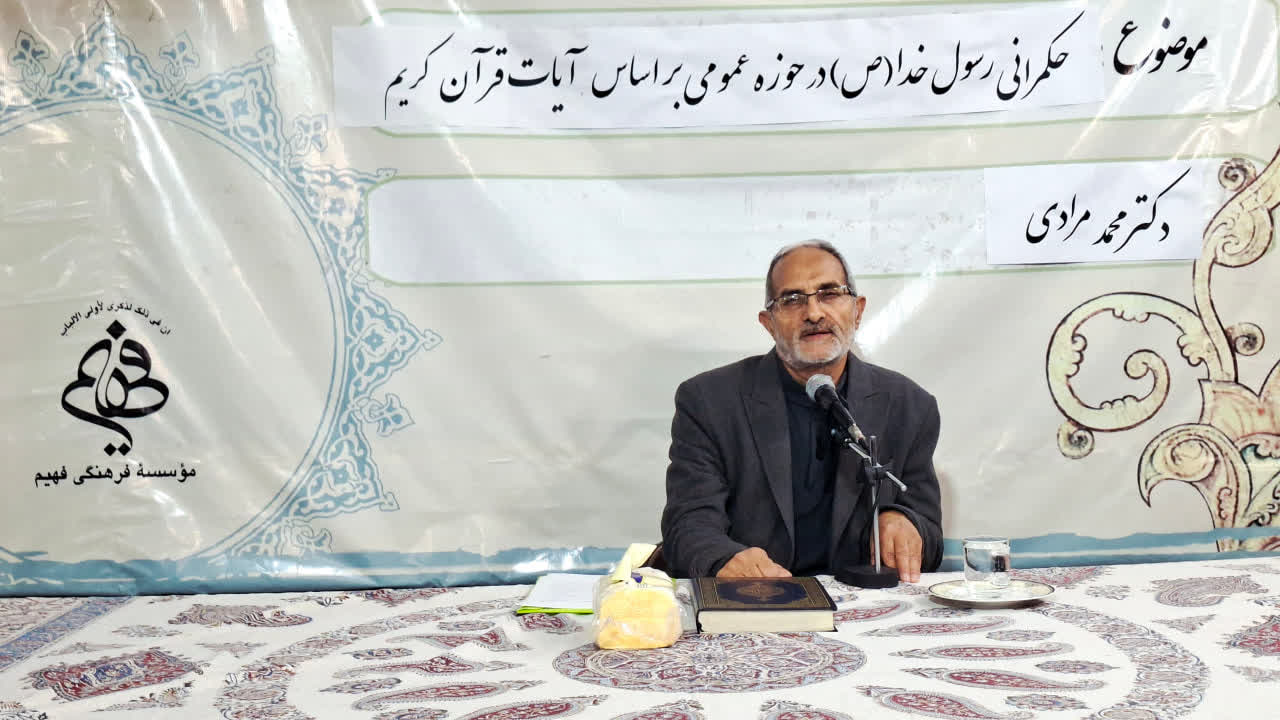
Lecture by Dr. Mohammad Moradi
بسم الله الرحمن الرحیم
الحمد لله رب العالمین و صلی الله علی سیدنا و نبینا ابوالقاسم محمد، صلوات الله و سلامه علیه و علی آله اجمعین.
I offer my greetings to the dear and honoured friends — those in whose presence we are, as well as those who may hear, or will hear, my words. I wish you all health and success, and I ask God Almighty to accept your acts of devotion.
We find ourselves in hard and difficult circumstances. Malicious enemies have attacked our dear country, and a number of our compatriots and dear commanders have been killed or have attained the grace of martyrdom. We ask God to elevate their ranks and to grant patience and fortitude to their families. We hope that God Almighty, by His Beautiful Names and His boundless power, will turn the evil of the enemies back upon themselves.
In this brief opportunity, I shall address a topic entitled “The Governance of the Messenger of God in the Public Sphere According to the Verses of the Noble Qur'an”. In these blessed days of the month of Ramadan — the month of the Qur'an and of the Divine Word — I shall endeavour to share a Qur'anic insight with you.
The truth is that the discussion I intend to present is multi-faceted or, so to speak, interdisciplinary; for it is connected on the one hand with theology (kalam), on the other with jurisprudence and history, and, most importantly, with the science of Qur'anic exegesis. Each of these disciplines has a share in this discussion, and its foundations can be examined within the fields mentioned; although in this short time it is not possible to address all of them, and I shall content myself with merely alluding to some points.
The main subject of this talk is the concept of “governance”. This term has become current in our country in recent decades; indeed, even worldwide it does not have a very long history, and it is less than a century since it was seriously put forward.
It should be noted that “governance” is not the same as “government”, although both are discussed in the field of political science. Government usually means the exercise of authority and power; that is, a structure that holds power and exercises it. Governance, however, does not necessarily mean the exercise of power, although in some cases it may be accompanied by it.
Hence a distinction must be drawn between these two concepts. When we speak of “the governance of the Messenger of God”, we do not necessarily seek to examine the structure of his government or its components; rather, we wish to see how the Prophet brought society along with him, how he involved people in public affairs, and how he advanced his social and religious undertakings.
It may be said that governance is a kind of involvement of all those who have a share in a common matter and who wish to realise a common goal. In this sense, government is only one of the components of governance; that is, the apparatus of power and politics, which stands alongside other factors.
In governance, the aim is not merely the exercise of power, but the creation of solidarity, participation and cooperation among the various groups of society in order to attain common goals. There may even be a kind of governance within a family; for example, a father who organises the affairs of the household with the cooperation of the family members.
Today, too, this term is used in various fields, such as governance of cyberspace, governance in education, cultural and artistic governance, and the like.
Interestingly, the concept of governance was first put forward in the field of economics. At one time it was thought that if production increased and capitalists engaged in more economic activity, economic problems would be solved; but experience showed that this is not so, and that it sometimes leads to the concentration of wealth, the formation of great economic powers and severe inequalities.
Economic thinkers therefore concluded that the structure of the economy needed to be reconsidered and that all economic actors — from workers to capitalists and experts — should participate in the process of decision-making and implementation. This idea was later carried over into the field of politics as well.
Some have defined governance as a newly emerged concept with a history of less than a century, regarded as the equivalent of the English term Governance — a concept that took shape in the West in the second half of the twentieth century and was at first economic in nature, but it gradually spread to various social and political arenas.
The World Bank defines governance as follows: a process in which people have the right to express their views, and governments must also be accountable for the policies that affect people's lives.
According to another definition, governance is a process in which various actors within a given domain, under appropriate guidance, move towards the realisation of a common goal agreed upon among formal and informal stakeholders.
In the definition of Islamic governance, too, it has been said: “the process of the faithful guidance and steering of power at the various levels of society for
In this definition, too, emphasis is placed on the interaction among various institutions, actors and stakeholders.
If we turn to the Noble Qur'an, we see that there is no direct term that exactly corresponds to the modern concept of governance. We must therefore approach this meaning through the concepts and expressions used about the Prophet in the Qur'an.
In the Qur'an, the Prophet is introduced with titles such as caller (da'i), guide (hadi), reminder (mudhakkir), conveyor of the message (muballigh) and sincere adviser (nasih); that is, one who invites, guides and reminds. But terms such as sultan, king or ruler are not used for him.
Indeed, in some verses it is explicitly emphasised that the Prophet has no dominion over people:
«لَسْتَ عَلَیْهِمْ بِمُصَیْطِرٍ»
or «لَسْتَ عَلَیْهِمْ بِوَکِیلٍ».
Nevertheless, in Medina the Prophet in practice held the leadership of society. He was both a religious leader and played a managerial role in the social and political arena; he was commander in war, concluded social compacts and administered society.
One of the most important examples of this social management is the “Constitution of Medina” or “Covenant of Medina”, a compact concluded among the Muslims, the Jews and the other inhabitants of Medina, which established a kind of shared social order.
Within this framework, the Prophet did not rely on force and formal structures of power to administer society; rather, he sought, by fostering faith-based and moral convictions, to encourage people to participate voluntarily in social affairs.
For example, in the matter of jihad there was no professional army or organised military force. The people of Medina, who in their daily lives were engaged in farming, animal husbandry or trade, would take up arms at the Prophet's call and stand alongside him
This is precisely what may be regarded as an example of governance: bringing the mass of the people along to realise a common goal.
One of the Prophet's most important means of achieving this was strengthening belief in the Hereafter and in divine reward. The mujahidun paid more attention to divine reward and to their standing in the Hereafter than to the spoils of war.
Alongside this, ethical conduct and the reform of social beliefs also played an important role. The Prophet endeavoured to transform tribal partisanship into a sense of social responsibility, so that people would regard themselves as responsible for the fate of society.
An example of this mode of governance can be seen in the verse «وَشَاوِرْهُمْ فِی الْأَمْرِ», where God commands the Prophet to consult the believers. Many exegetes have said that this consultation was intended to secure participation and strengthen the spirit of solidarity among the Muslims.
The Prophet's consultation in battles such as Uhud and the Trench (al-Khandaq) also shows that, in order to bring people along with him, he would ask their opinion and sometimes even act on the basis of those very opinions.
In sum, it may be said that the Prophet's governance was founded on bringing people along with him, their moral education, the reform of their beliefs and their involvement in public affairs. This model led people to participate in social and religious affairs not out of compulsion but out of inner motivation.
I thank you for your attention and patience, and I hope that God will include us all in His mercy and blessing in this blessed month of Ramadan and turn the evil of the enemies back upon themselves.
والسلام علیکم و رحمه الله و برکاته the realisation of the public good and humanity's attainment of happiness in this world and the Hereafter.”
Comments
No comments yet. Be the first.
Write a note, critique or commentShare your view with us and other readers without leaving this page.