


«بِسْمِ اللَّهِ الرَّحْمَنِ الرَّحِيمِ»
«حَسْبُنَا اللَّهُ وَ نِعْمَ الْوَكِيلُ، نِعْمَ الْمَوْلَى وَ نِعْمَ النَّصِيرُ، ثُمَّ الصَّلَاةُ وَ السَّلَامُ عَلَى سَيِّدِنَا وَ نَبِيِّنَا أَبِي الْقَاسِمِ الْمُصْطَفَى مُحَمَّدٍ صَلَّى اللَّهُ عَلَيْهِ وَ آلِهِ وَ سَلَّمَ.»
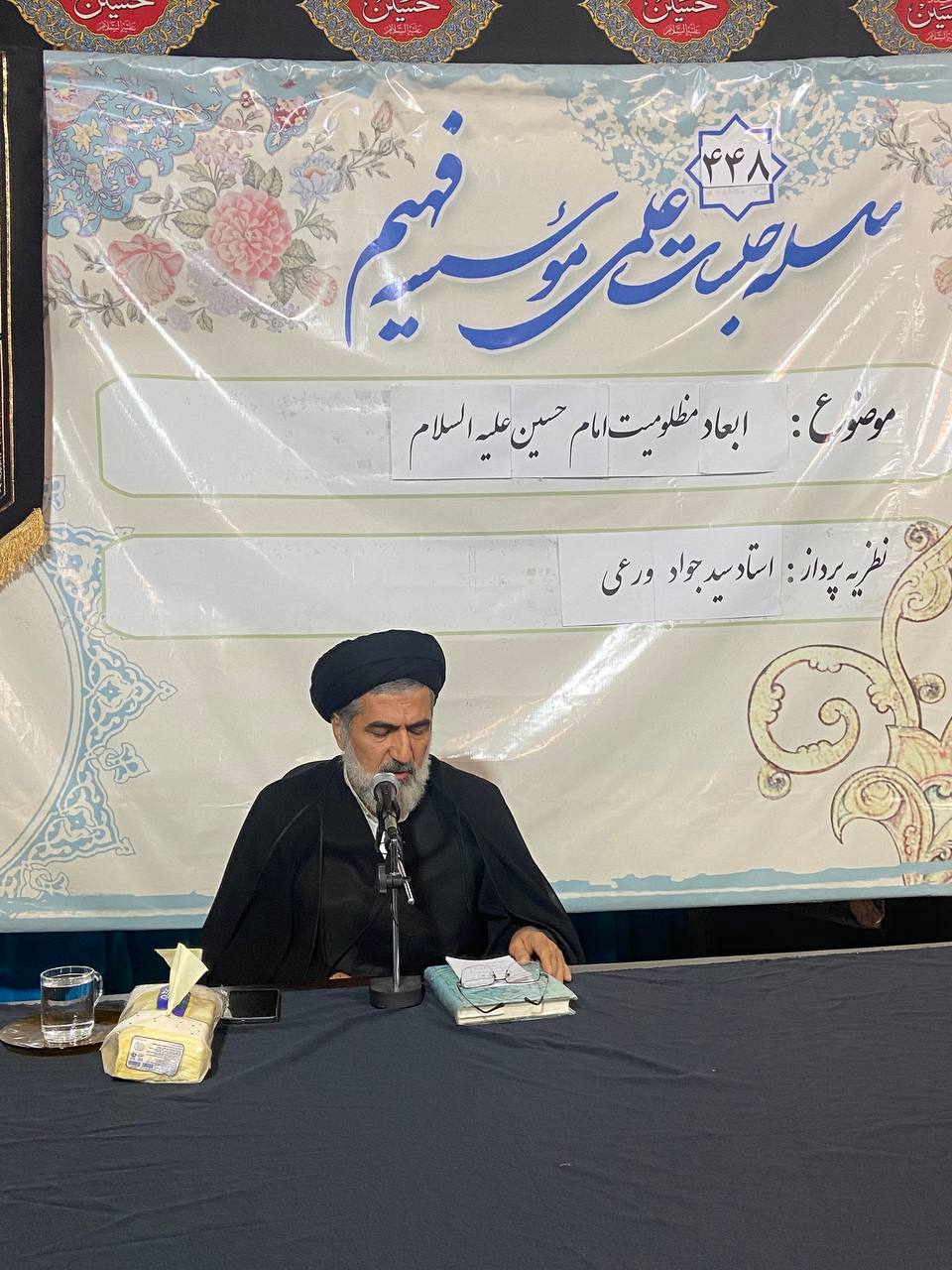
I offer my condolences to the esteemed audience and the honourable professors on the days of mourning for Aba Abdillah al-Husayn (AS).
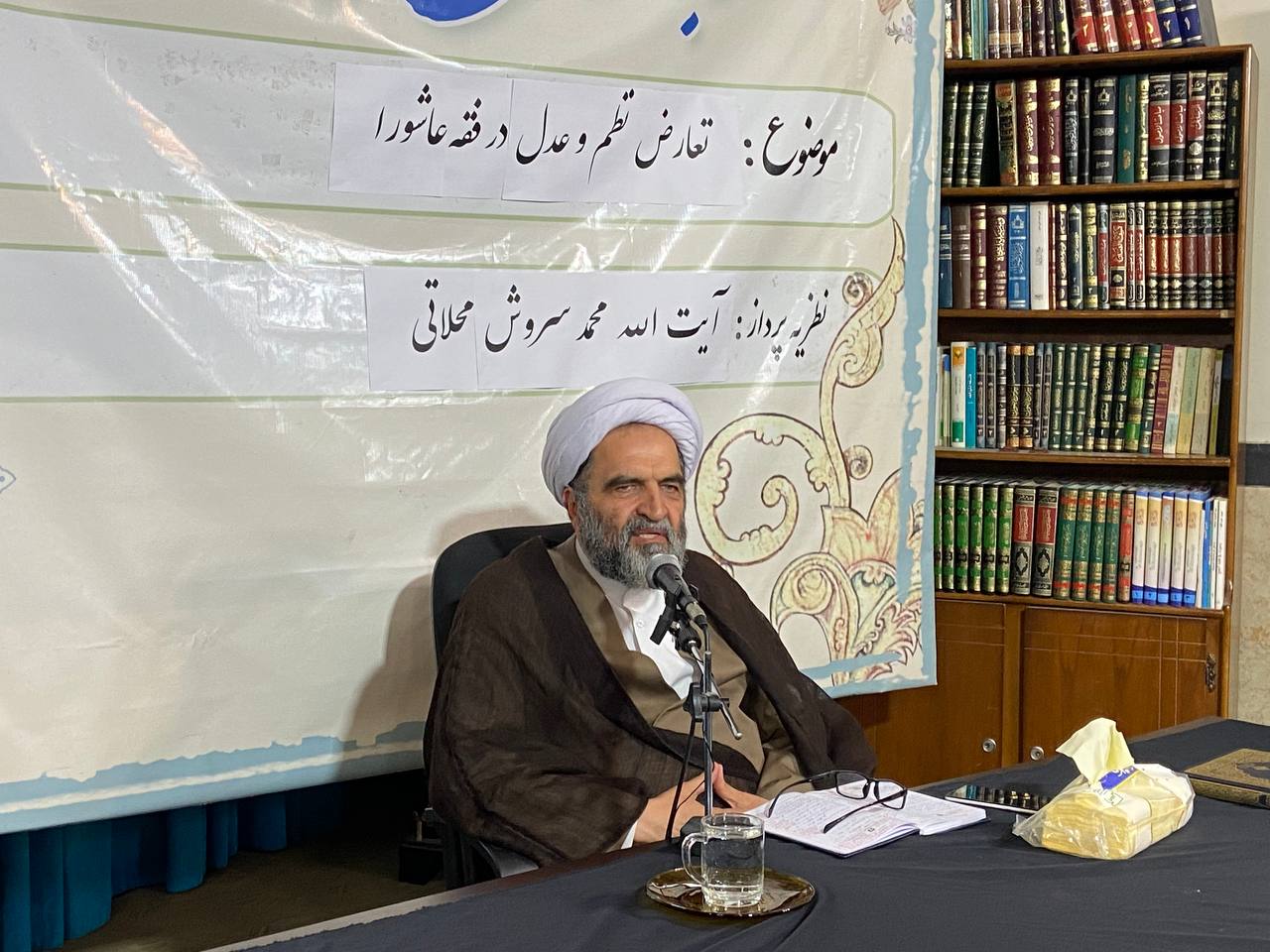
One of the most important issues that, from the very time of the event of Ashura and even in its preliminary stages, has always been debated among Muslims and remains so today is the fundamental question of whether Imam Husayn (AS), through his political movement of protest against the government, did not create a kind of discord and division within the Islamic Ummah. This question is examined at times from a historical perspective, at times from a political angle, and at times with a precise juristic outlook.
From the juristic perspective, the problem is formulated as follows: when an unjust and oppressive ruler holds power and is in complete control, if struggling against and confronting him in order to attain justice entails consequences such as the emergence of discord, chaos and disorder in society, what is the religious obligation? Here we face a choice between “the preservation of order” and “the attainment of justice”. This paradox has been raised ever since the uprising of Aba Abdillah al-Husayn (AS), continues to this day, and has had profound effects on the social and political destiny of Muslims. Before entering the main discussion, I shall briefly present a few short preliminaries to you, dear friends, and then, to the extent of my ability and the time available to me, I shall proceed to explain the matter.
The Conflict Between Order and Justice in the View of Sunni Historians and Thinkers
Historians who have devoted themselves mostly to the social and political analysis of events have usually focused on the point of whether the movement of Imam Husayn (AS), which outwardly caused a split in the Ummah, was essentially a permissible and legitimate movement or not. It is clear that for us Shi‘as the raising of this question is fundamentally baseless; but among the Sunnis and analysts of social issues, this subject is of particular importance.
For example, Ibn Khaldun, in his History, expresses an opinion about the movement of the Master of Martyrs (AS) that reflects precisely this approach. Pointing out that the Companions in general did not agree with the course taken by Imam Husayn (AS), he explains the reason for this opposition as follows: in their view, rising against an unjust ruler has grave consequences, leads to chaos and brings about corruption; hence the best interest lies in tolerating the oppressive ruler and taking no action against him. His words are as follows:
«أَمَّا غَيْرُ الْحُسَيْنِ مِنَ الصَّحَابَةِ الَّذِينَ كَانُوا بِالْحِجَازِ وَ مَعَ يَزِيدَ بِالشَّامِ وَ الْعِرَاقِ وَ التَّابِعِينَ لَهُمْ، فَرَأَوْا أَنَّ الْخُرُوجَ عَلَى يَزِيدَ ـ وَ إِنْ كَانَ فَاسِقاً ـ لَا يَجُوزُ، لِمَا يَنْشَأُ عَنْهُ مِنَ الْهَرْجِ...»
(As for the other Companions in the Hijaz, and those with Yazid in Syria and Iraq, and their Followers, they held that rising against Yazid, even though he was corrupt, was not permissible, because of the chaos and turmoil that would arise from it.)
Ibn Khaldun explicitly states that although Yazid was corrupt, rising against him was not permissible, because rebellion against the leader brings disorder, and the harm of this disorder is far greater than the harm of having an unjust ruler at the head of power. The same view is also seen in other sources, both in the books of Sunni historians and of Sunni hadith scholars. Ibn Kathir, in his book al-Bidaya wa al-Nihaya, explicitly states that even if the leader of society is corrupt, rising against him is still forbidden:
«لَا يَجُوزُ الْخُرُوجُ عَلَيْهِ، لِمَا فِي ذَلِكَ مِنْ إِثَارَةِ الْفِتْنَةِ وَ وُقُوعِ الْهَرْجِ وَ سَفْكِ الدِّمَاءِ وَ نَهْبِ الْأَمْوَالِ»
(Rising against him is not permissible, because it causes the kindling of strife, the occurrence of chaos, bloodshed and the plundering of property.)
Therefore, the prevailing view among them was that the harms of disrupting order are greater than the harms of the unjust ruler himself, and that one must remain patient until the end of his rule. Beyond these historical analyses, at the very time when Aba Abdillah al-Husayn (AS) intended to begin this movement, more or less all those who became aware of the affair faulted him with precisely this argument. At that time, no one defended Yazid ibn Mu‘awiya personally or considered him worthy of leading the Ummah; yet they constantly insisted that confronting him was not in the interest of the Islamic community and that such an action would bring widespread disorder and corruption upon the people at large.
The rulers, too, used exactly this argument as a pretext for suppression. The expression that ‘Amr ibn Sa‘id, the governor of Medina, addressed to Aba Abdillah al-Husayn (AS) was: «تُفَرِّقُ بَيْنَ الْأُمَّةِ» (You are sowing division within the Ummah!). That is, the agents of the government called this movement a form of divisiveness, and other members of society also refused to accompany the Imam on the basis of this same conservative justification.
The Precedence of Order over Justice: Tracing the Roots of Despotism in Islamic Societies
We can examine this approach, that is, the issue of “the importance of political order and its precedence over lofty values such as justice and freedom”, in two different schools of thought: first in the Sunni school, and then in the school of the Ahl al-Bayt (AS).
Among the Sunnis, the prevailing tendency has always been that the ruling order must not be disrupted on the pretext of the corruption and tyranny of the rulers. The late Dr. Hamid Enayat, who was a distinguished specialist in the social sciences, analyses this issue in his valuable book entitled A Survey of Arab Political Thought from the perspective of Sunni thinkers such as al-Mawardi, al-Ghazali and Ibn Jama‘a. He shows clearly to what extent these thinkers regarded “obedience to the sultan” as intrinsically valid and an end in itself; to the point that they explicitly issued fatwas that there is no difference between a just leader and an unjust leader, and that the order of society must not be disrupted under any pretext.
In analysing this approach, Dr. Enayat writes that the conflict between obedience to the ruler and the observance of justice was always resolved in favour of the ruler, on the pretext of preserving the social order of Muslims. He goes on to add: once a society accepts that, by the dictate of necessity, justice may be sacrificed for social order, it will all the more readily consent to sacrificing individual and political freedoms for the survival of order as well, and will submit to despotism and dictatorship.
The fruit and outcome of the ideas that the likes of al-Ghazali and al-Mawardi promoted in Islamic society was that Muslims accepted that they must tolerate the rule of tyrants. More precisely, these ideas gradually conditioned the mentality of Muslims to accept despotism, in such a way that in the political system of Islamic societies despotism became the “rule” and freedom became the “exception”. For rulers could easily suppress any striving for freedom on the pretext of sedition and of undermining the security of the Ummah. The turbulent history of Islamic countries is clear testimony to this bitter truth: the sanctification of the ruling order at the cost of sacrificing the greatest human values, such as justice and freedom. Islamic societies have paid a heavy price throughout history for this intellectual deviation and, unfortunately, are still paying it.
The Narrative Proofs of the School of the Caliphs in Justifying the Status Quo
The main argument of those who theorised these foundations is their reliance on certain narrations transmitted in Sunni sources. Ibn Kathir, in the same book al-Bidaya wa al-Nihaya, after declaring rising against the ruler illegitimate, relies on a narration considered reliable among them and writes:
«مَنْ جَاءَكُمْ وَ أَمْرُكُمْ جَمِيعٌ، يُرِيدُ أَنْ يُفَرِّقَ بَيْنَكُمْ، فَاقْتُلُوهُ كَائِناً مَنْ كَانَ»
(If there is consensus in a community and someone comes among you to create division between you, kill him, whoever he may be!)
In this logic, it does not matter at all what the argument of the protester is or how unqualified the ruler of the time is; the mere creation of discord is considered a religious licence for killing him. A similar content is also found in the Musnad of Ahmad ibn Hanbal:
«مَنْ رَأَيْتُمُوهُ يُفَرِّقُ بَيْنَ أُمَّةِ مُحَمَّدٍ (صَلَّى اللَّهُ عَلَيْهِ وَ آلِهِ وَ سَلَّمَ) وَ هُمْ جَمِيعٌ، فَاقْتُلُوهُ كَائِناً مَنْ كَانَ مِنَ النَّاسِ»
And in Sahih Muslim we read:
«مَنْ أَتَاكُمْ وَ أَمْرُكُمْ جَمِيعٌ عَلَى رَجُلٍ وَاحِدٍ، يُرِيدُ أَنْ يَشُقَّ عَصَاكُمْ أَوْ يُفَرِّقَ جَمَاعَتَكُمْ، فَاقْتُلُوهُ»
(If you are all under the command of one man, and someone comes to break your unity and scatter your community, put him to death.)
It was on the basis of these very narrations and proofs that that ignorant man (the judge of the Umayyad establishment), citing the words of the Prophet (PBUH) himself, issued a juristic ruling and said: «قُتِلَ الْحُسَيْنُ بِسَيْفِ جَدِّهِ» (Husayn ibn Ali was killed by the sword of his grandfather!). That is, the criminals of Karbala brought about such a catastrophe under the illusion that they were acting upon the command of the Messenger of God and striving to preserve order and to counter divisiveness.
The Approach of the School of the Ahl al-Bayt (AS) and the Resolution of the Dilemma of Conflict
Among us Shi‘as, however, the matter is entirely different. In our school there is neither such a dark history of supporting oppressors, nor are our narrative proofs placed in the service of ruling power in this way. If we wish to analyse this issue on the basis of our own foundations, the discussion can be examined from two angles: rational and textual.
From the rational aspect, this issue is one of the instances of the chapter of “conflict” (tazahum) in the science of usul; that is, a conflict between the criteria (malakat) present in the preservation of order and the criteria inherent in the establishment of justice. If the implementation of justice leads to the disruption of order, and on the other hand the preservation of social order causes justice to be lost, we are faced with a conflict. The clear principle of usul here requires us to see which of these two criteria has greater “importance” (تقديم الأهم على المهم – giving precedence to the more important over the important).
One cannot rule in a general and absolute manner that under all circumstances the survival of political order takes precedence over everything else, even if the rulers commit every kind of crime! One must carefully weigh what harms will result if the existing order is preserved, and what consequences will follow if protest and outcry are raised against it. Sometimes the benefits of breaking an oppressive order and rising up are far greater and prevent much greater harms. In the Shi‘i school we have no general rational proof establishing that order is sacred in every situation and under the banner of every government.
Beyond this, in our analytical framework, “order” lacks intrinsic value, whereas “justice” possesses intrinsic goodness. Fundamentally, order cannot be placed on the same level and rank as justice so as to come into conflict with it. If we attach any value to government and political order, it is merely instrumental; that is, we want order so that in its light the rights of human beings are respected, aggression and oppression are prevented, and justice is established. Thus a phenomenon that has no intrinsic value (order) is valuable only to the extent that it serves a phenomenon of intrinsic value (justice). Those who have been unaware of this rational subtlety have easily been deceived and, in their social analyses, have given precedence to the fact of governing over “how to govern”.
It is a source of pride that our great figures and foremost scholars in the various Islamic sciences have always emphasised this point. In the present age, the late Allamah Tabataba'i (may God be pleased with him), in the noble exegesis al-Mizan (volume fifteen, in the social discussions), has addressed exactly this issue. He states that the harms of endorsing unjust governments that oppress the people are far greater than the costs paid for protest and uprising. In a most illuminating passage, the Allamah says:
«وَ قَدْ تَبَيَّنَ الْيَوْمَ بِالْأَبْحَاثِ الِاجْتِمَاعِيَّةِ، أَنَّ إِمْضَاءَ حُكُومَةِ مَنْ لَا يَحْتَرِمُ الْقَوَانِينَ الْمُقَدَّسَةَ الْجَارِيَةَ... لَا يُصَادِقُ عَلَيْهِ مُجْتَمَعٌ عَاقِلٌ رَشِيدٌ.»
(It has become clear today through social research that endorsing and ratifying the rule of an oppressor who does not respect sacred laws and whose hand is free in violating the laws is something that no rational, mature and cultured society accepts.)
He then adds that no wise person submits to such degradation, so how could anyone attribute this silence in the face of oppression to the religion of God?
«فَمِنَ الْوَاجِبِ تَنْزِيهُ سَاحَةِ الدِّينِ عَنْ أَنْ يَنْزِلَ إِلَى هَذَا الدَّرْكِ.»
(It is obligatory to keep the sanctuary of religion free from descending to such a low level.)
In response to those who deem silence and tolerance towards the oppressor obligatory under the heading of “preserving Islamic unity”, the late Allamah takes a decisive position and says:
«وَ الْقَوْلُ بِأَنَّ مَصْلَحَةَ حِفْظِ الْوَحْدَةِ وَ اتِّفَاقِ الْكَلِمَةِ أَهَمُّ مِنْ حِفْظِ بَعْضِ الْأَحْكَامِ... مَعْنَاهُ جَوَازُ هَدْمِ حَقِيقَةِ الدِّينِ بِحِفْظِ اسْمِهِ.»
(For someone to say that the interest of preserving the unity of society is more important than preserving the fundamental rulings of religion means that destroying the reality and substance of religion in order to preserve its shell and outward form is permissible!)
Truly, what fruit and function does a unity have whose content is not the implementation of justice and the establishment of divine rulings?
Examining a Challenging Sermon in Nahj al-Balagha
Up to this point the rational discussion has become clear; but when it comes to textual evidence and narrations, the task becomes somewhat complicated (just as the Sunnis, too, slipped by relying on their narrations). In referring to our own narrative sources, we too must proceed with careful consideration and deep ijtihad, for at times we encounter texts that require serious reflection.
One of these challenging texts is a statement that the late Sayyid al-Radi has transmitted from the Commander of the Faithful (AS) in Sermon 127 of Nahj al-Balagha. Here I ask the eminent professors honouring this gathering with their presence to reflect and think along with me in understanding this saying of Ali. This sermon was delivered in the context of the affair of the Kharijites and the issue of arbitration, and the Imam, in rebuking the Kharijites for having separated their ranks from the Muslims, says:
«إِلْزَمُوا السَّوَادَ الْأَعْظَمَ، فَإِنَّ يَدَ اللَّهِ مَعَ الْجَمَاعَةِ. وَ إِيَّاكُمْ وَ الْفُرْقَةَ، فَإِنَّ الشَّاذَّ مِنَ النَّاسِ لِلشَّيْطَانِ، كَمَا أَنَّ الشَّاذَّ مِنَ الْغَنَمِ لِلذِّئْبِ. أَلَا مَنْ دَعَا إِلَى هَذَا الشِّعَارِ فَاقْتُلُوهُ، وَ لَوْ كَانَ تَحْتَ عِمَامَتِي هَذِهِ.»
(Always stay with the great majority [the great mass of the people], for the hand of God is with the community. Beware of division, for the person who separates from the community is prey to Satan, just as the sheep that separates from the flock becomes prey to the wolf. Beware, whoever calls to this [divisive] slogan, kill him, even if he be beneath this turban of mine!)
How are these sentences to be understood according to their apparent meaning? Do these words not mean that one must always obey the majority and not create opposition and discord in society? Do they not indicate that any distancing from the general path is equivalent to falling into the trap of Satan?
If we accept this apparent reading, how can we reconcile it with the practical conduct of Aba Abdillah al-Husayn (AS)? Imam Husayn (AS) rose up precisely in a society the overwhelming majority of which had, through pressure, bribery or threats, sat at Yazid's table. At the start of the movement, even foremost figures such as ‘Abdullah ibn Ja‘far, ‘Abdullah ibn ‘Umar and ‘Abdullah ibn al-Zubayr refused to accompany the Imam and explicitly faulted his movement. Was the Imam's uprising not (God forbid) an instance of separation from the “great majority”? On the other hand, how should that severe command of the Commander of the Faithful (AS), who said: «أَلَا مَنْ دَعَا إِلَى هَذَا الشِّعَارِ فَاقْتُلُوهُ», be analysed? Does every dissenter who says something contrary to the general current of society deserve execution?
The Answers of the Commentators of Nahj al-Balagha and Their Evaluation
The esteemed commentators of Nahj al-Balagha have tried, under this sermon, to untie this epistemic knot. However, when one refers to these commentaries with scholarly precision, one finds that some of the justifications do not appear particularly satisfying or convincing.
- Restricting the “great majority” to the community of the people of truth: Great scholars such as the late Allamah Muhammad Taqi Ja‘fari, Ayatollah Makarim Shirazi and Ayatollah Jawadi Amuli (may God preserve them) have stated in their valuable commentaries that what the Commander of the Faithful meant by “the community” and “the great majority” is the community of the people of truth; therefore, if the majority of a society are people of falsehood, accompanying them is not permissible, and this separation will never be an instance of blameworthy division. This interpretation is entirely consistent with the doctrinal foundations of Shi‘ism, for we Shi‘as have always been in the minority throughout history, and had we been obliged to submit completely to the majority, no school would have survived at all from the very day after the passing of the Noble Messenger (PBUH).
- Objection to this answer: With all respect to the station of these great scholars, a question arises here: if what the Imam meant were merely “the people of truth”, then the attribute of “majority” and “community” would no longer have any relevance here! This issue resembles the discussion of “consensus” (ijma‘) in the science of usul. For the Sunnis, unanimity of opinion and the large number of people are in themselves relevant and authoritative; but in the Shi‘i school, the validity of consensus lies solely in its revealing the opinion of the Infallible (AS). If we know the view of the Infallible Imam, it is authoritative for us even if the whole world opposes it. Therefore, when the criterion of truth is clear, the number of people present or absent has fundamentally no bearing.
- The interpretation of “this slogan” and the ruling of killing: Regarding the phrase «أَلَا مَنْ دَعَا إِلَى هَذَا الشِّعَارِ فَاقْتُلُوهُ», some, such as Ayatollah Jawadi Amuli in his commentary (entitled «سَلُونِي قَبْلَ أَنْ تَفْقِدُونِي»), have stated that the word “the slogan”, by indication of the context of the speech, refers to that very divisive slogan and the disruption of the unity of society. That is, anyone who threatens national security and independence through self-will deserves to be killed. In the commentary of Ayatollah Makarim Shirazi it is also stated that, since the slogan of the Kharijites led to bloodshed and corruption on earth, the supporters of this slogan were condemned to execution.
- Historical objection: If this were so, the consequence would be that the Commander of the Faithful (AS) should have executed every single one of the Kharijites merely for the offence of holding this belief and raising this slogan, even if they had not taken up the sword! Whereas history shows that the Imam fought only those who rose in armed rebellion, and after the Battle of Nahrawan he ordered that the remaining Kharijites be left alone.
- Interpreting it as a specific external case (the view of Ayatollah Montazeri): To resolve this difficulty, the late Ayatollah Montazeri holds that this command of the Imam is not a “universal ruling” for all ages, but rather a “specific external case” (qadiyya kharijiyya) that pertains exclusively to that particular group of Kharijites. The Kharijites of that time committed extraordinarily horrific crimes (such as ripping open the bellies of pregnant women and highway robbery), and confronting them was a clear instance of legitimate self-defence. He has interpreted the word «فَاقْتُلُوهُ» as denoting “permission” rather than “obligation”; that is, the Imam said that your lives and property are in danger and you are “permitted” to kill them in self-defence. Evidence for this claim is that the Commander of the Faithful (AS), after repelling their evil at Nahrawan, said that the Kharijites should no longer be bothered.
Moreover, alongside these discussions of chain of transmission and signification, when we search the sources before and after Nahj al-Balagha (sources such as the History of al-Tabari or the Amali of al-Saduq, in which Sermon 127 is transmitted with various chains), the phrase «أَلَا مَنْ دَعَا إِلَى هَذَا الشِّعَارِ فَاقْتُلُوهُ...» is not to be found in any of them, and it seems that this ending is one of the additions that require more precise historical investigation and tracing of origins.
The Mission of the Hawzas: The Necessity of Developing a Jurisprudence of Ashura
Drawing these discussions together and responding to these doubts is no easy task and requires deep scholarly seminary deliberation. My purpose in raising this issue among you learned scholars and experts was to direct minds in this direction so that you pursue these discussions seriously. The issue goes far beyond a purely historical discussion; we need a fundamental transformation in our scholarly foundations.
Today, even among the Sunnis, who once supported the unjust rulers of history so intensely, an awakening and transformation has taken place. Intellectuals such as ‘Abd al-Rahman al-Kawakibi have emerged who say explicitly: if the ruling order cannot lead us to justice, civil rights and Islamic values, what value does preserving this hollow shell have? They are revising their decayed and traditional ideas. We must take care not to fall into the trap of conservatism.
We possess immense resources of which others are deprived. The utmost understanding of the likes of Ibn Khaldun regarding the uprising of the Master of Martyrs (AS) is to say: “Husayn was a mujtahid, but he erred in his uprising!” They do not have a model such as Imam Husayn (AS), but we do. We must enter the arena with full hands and show which values take precedence in the epistemic geometry of the “jurisprudence of Ashura”, and for the preservation of which principles one must sacrifice even one's life.
I acknowledge that the presentation of this discussion in this short time was incomplete. I had prepared many notes, but since my forty-five minutes are coming to an end and I do not wish to impose on your time any further, I shall suffice with this much.
Comments
No comments yet. Be the first.
Write a note, critique or commentShare your view with us and other readers without leaving this page.