


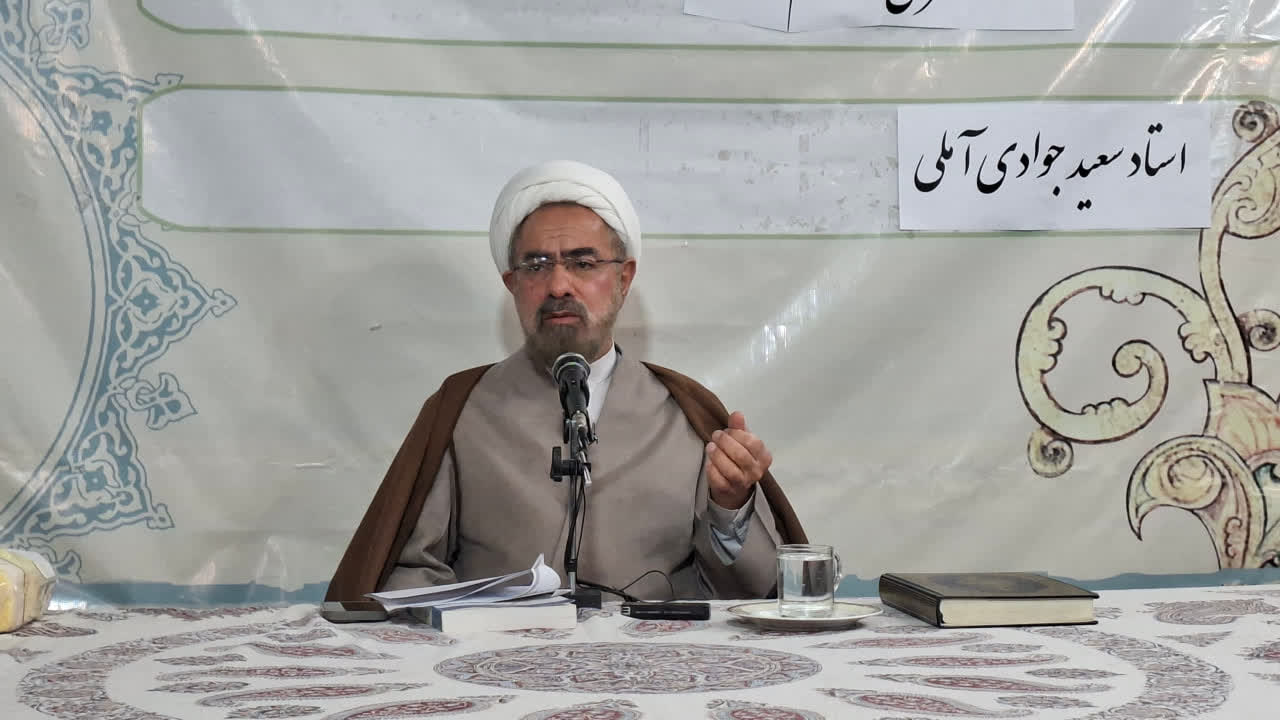
Text of the lecture delivered by Professor Morteza Javadi Amoli at the Fahim Institute, Ramadan 1447
اعوذ بالله من الشیطان الرجیم
بسم الله الرحمن الرحیم
الحمدلله رب العالمین و صلی الله علی جمیع الأنبیاء و المرسلین، سیّما خاتمهم و أفضلهم، حبیب إله العالمین، أبیالقاسم المصطفی محمد، و صلّی الله علی آله الطاهرین، لا سیّما خاتم الأوصیاء، حجّة بن الحسن العسکری، أرواحنا له الفداء.
اللهم ارزقنا إیماناً تباشر به قلوبنا، ویقیناً صادقاً حتی نعلم أنَّه لن یصیبنا إلا ما کتبت لنا، ورضِّنا من العیش بما قسمت لنا، یا أرحم الراحمین.
The great nights of the blessed month of Ramadan, and especially the final ten days of this month, which are known for i'tikaf and supplication, bring forth for us the highest manifestations of servitude to God. We thank and give praise to the Lord of the worlds for granting all of us the opportunity to witness this month, these nights, these days, these hours, days and nights.
This month became bound up with jihad and intermingled with martyrdom, and the garden of our dear Islamic Iran was immortalised in history in the blessed month of Ramadan of the year 1447 of the lunar Hijri calendar and 1404 of the solar Hijri calendar. A movement that has unfolded over more than forty years has now reached one of its manifestations, namely the shattering of the prestige of global arrogance and of the world domination of America and international Zionism.
We hope that the Islamic Ummah will awaken; indeed, the dawn and first signs of this awakening have already appeared in Muslim societies, and the valuable and powerful movements of the dear Hezbollah in Lebanon, and of the valiant mujahidin and fighters of Iraq, Yemen and other parts of the Islamic world, bear witness to a light and radiance in the world of Islam.
The efforts and endeavours of the beloved Imam, the great architect of the Revolution, of the esteemed Leader of the Revolution, and of the martyrs who laid firm the foundations of resistance in this region have borne fruit today, and we now witness the blossoms of this resistance.
First of all, for the martyrs of this great arena, especially the martyrs of the blessed month of Ramadan, and for all those who attained martyrdom on this path, we ask the Divine Court for mercy and divine good pleasure. For all of them, from the newly departed martyrs to the noble martyrs in the farthest corners of the Islamic lands, we seek forgiveness. Kindly recite a Fatiha for the joy of all their souls.
اللهم صل علی محمد و آل محمد.
Although one of the finest programmes of the nights of the blessed month of Ramadan is scholarly dialogue, intellectual discussion and the presentation of views on theological questions, given the circumstances in which we find ourselves these days, and given that our nights and days are spent escorting the pure and dismembered bodies of the martyrs, the atmosphere is not quite suited to such discussions.
Nevertheless, this programme had been planned before the blessed month of Ramadan, and I too had promised on two occasions to be in the service of the esteemed audience and to present whatever I might have to offer. Divine decree ordained that this session be held at this time; for divine decree orders all affairs and holds us within the fingertips of its governance.
One of the most contested questions in the discussions of human society today, even in religious societies, is the question of governance.
There are two kinds of governance in the order of existence:
1- Governance in the order of creation (takwin)
2- Governance in the order of legislation (tashri')
In the order of creation, God, the Glorified and Exalted, is the Possessor of all sovereignty. Whatever He has created, He has created with the utmost perfection and in the best form. Our philosophers have explained this matter under the heading of the best possible order of existence (al-nizam al-ahsan).
God, the Lord of the worlds, possessing the utmost knowledge, power, generosity and bounty, creates whatever He creates in the most perfect form possible; nothing higher than it can be conceived. For this reason, whatever issues from Him is also of the highest rank. «و ما أمرنا إلا واحدة».
All the multiplicities that we see in the world are manifestations of that single reality. Whatever exists in the order of existence, from pre-eternity to post-eternity, is a manifestation of that one reality, even though it has appeared in diverse forms and loci of manifestation.
This holds true not only in creation but also in nurturing and lordship (rububiyyah). From the smallest particle to the greatest galaxies, all exist within the best order of creation and governance: «ربنا الذی أعطی کل شیء خلقه ثم هدی». Thus, in the order of creation, man can only gaze in wonder and say: «ربنا ما خلقت هذا باطلاً سبحانک فقنا عذاب النار».
In the domain of legislation, however, the matter is different. The most contested question in the order of existence is legislative governance, because here there are two wills:
The divine will
The human will
The divine will seeks to raise man from the level of nature to the heights of the celestial realm (malakut). The human will, however, mostly moves along the path of pleasure, profit-seeking and worldly interests. It is precisely here that the challenge takes shape. From the time of Abel and Cain until today, this conflict between the divine will and the human will has continued. God, the Lord of the worlds, has shown an example of the union of these two realities in the order of creation: the union of soul and body. The soul is a bird of the celestial realm; the body is a material being with animal inclinations. Yet God placed these two side by side and said: «فتبارک الله أحسن الخالقین». In the order of legislation, however, this same matter is far more difficult, because man possesses selfishness, pretension and at times even a claim to lordship, the very thing that became manifest in Pharaoh: «أنا ربکم الأعلی». Of course, this state was not confined to Pharaoh; it exists potentially in every human being. If the conditions of power are provided, it may come to the surface. Therefore, the fundamental question in legislative governance is how the divine will and the human will can be brought together. If man is left without the guidance of revelation, the result is what we see in the world today: arrogance, colonialism, exploitation and domination. Human rights become a slogan, and even international organisations remain powerless before the dominating powers.
The aim of divine legislation is for man to rise from the level of nature to the heights of the celestial realm. Man, however, mostly wishes to remain in this world, to take pleasure and to pursue profit. From here arises the question of man as an unfinished project. God wishes to bring man to perfection, but man resists this path. The solution to this problem in our religious teachings is the system of Imamate and Ummah.
The Noble Prophet said: «من مات و لم یعرف إمام زمانه مات میتة جاهلیة». His Eminence Ayatollah Javadi Amoli says in this regard: ignorance (jahl) is one thing, foolishness (jahalah) is another, and Jahiliyyah is a third. What removes Jahiliyyah is the system of Imamate and Ummah. In this system, the human will is subsumed into the divine will; not that it is annihilated, but rather that it is absorbed and given direction within it.
In the modern world, various structures of government have taken shape: the parliamentary system, the separation of powers, the republic, civil rights and the like. These are achievements of modern civilisation and cannot be ignored. The question, however, is how these structures can be harmonised with the system of Imamate and Ummah. In the Islamic Republic we have tried to carry out a kind of simulation, in such a way that republicanism plays the role of the Ummah and Islamicity plays the role of the Imam. But the fundamental question is whether this combination has been properly formed. Is the dichotomy of legitimacy and acceptability sound in the first place?
Can something that is not accepted by the people be legitimate?
These are serious questions that must be reflected upon.
The structure of Islamic government must also be subjected to serious review. The links and connections between the components of government must be precise and logical, like the structure of a building whose edifice will have no stability if its joints are not sound.
Matters such as the separation of powers, the role of the Guardian Council, the relationship between legislation and execution, and many other issues require profound examination. What can open the way is the very system of Imamate and Ummah that is the legacy of the divine prophets. In the era of the presence of the Infallible Imam, there are two fundamental elements:
Infallible knowledge
Infallible justice
In the era of Occultation, however, these two elements are not fully at our disposal, and this makes the task more difficult. For this reason, it is necessary for the hawza and the university, through extensive scholarly effort, to reflect further on the structure of Islamic governance. In closing, I sincerely thank all the honourable persons who made this opportunity possible, especially the dear friends at the Fahim Institute and the esteemed professors and scholars who graciously attended. I hope that God Almighty will accept these efforts and grant all of us success on the path of serving Islam.
In closing, we once again ask for mercy for the martyrs, for the great figures of this system, and for all those who sacrificed their lives on this path. We hope that God will also make us partners in the reward of this great movement.
I thank you all.
والسلام علیکم و رحمة الله و برکاته.
Comments
No comments yet. Be the first.
Write a note, critique or commentShare your view with us and other readers without leaving this page.