


بِسْمِ اللهِ الرَّحْمٰنِ الرَّحِيمِ
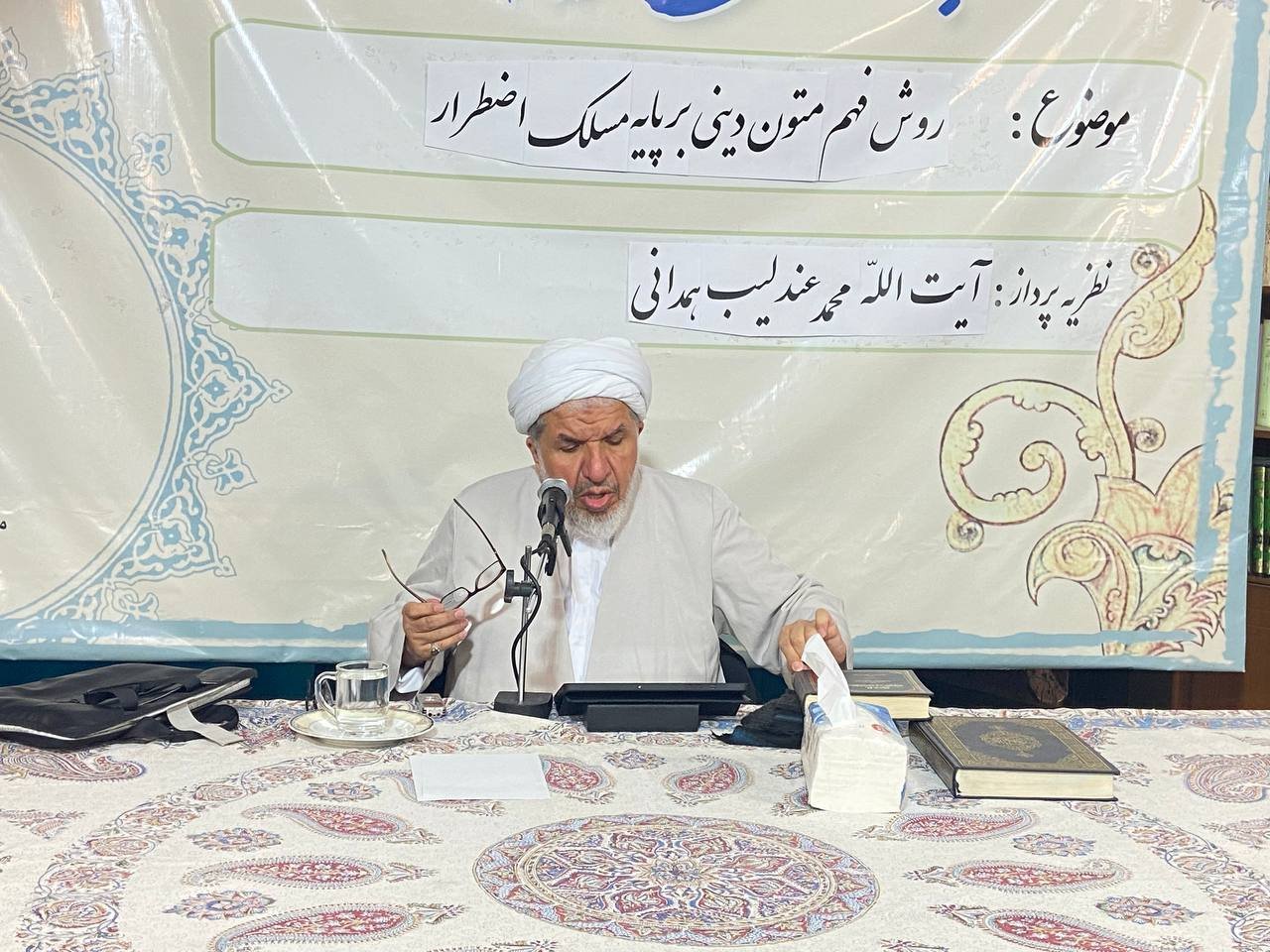
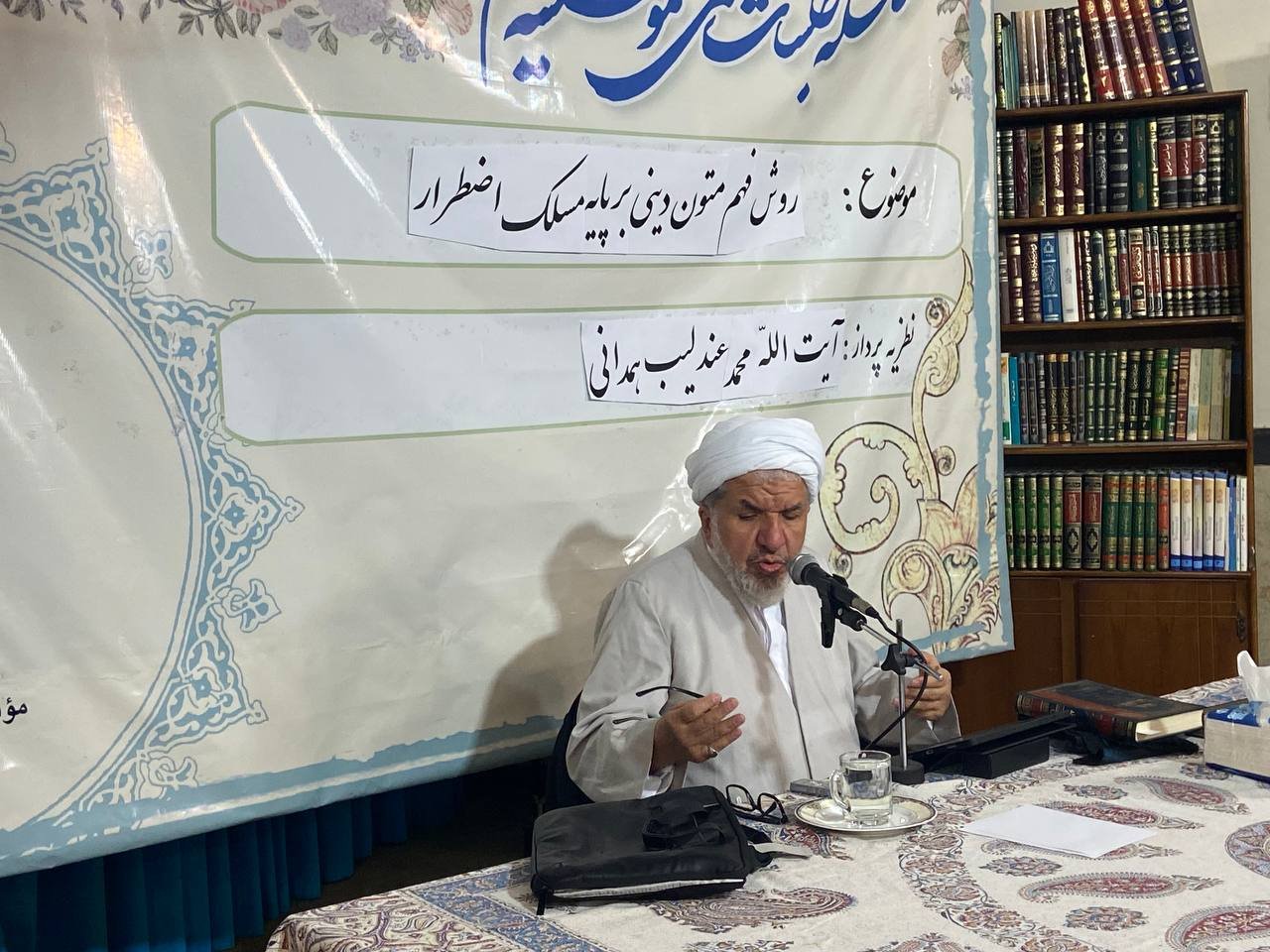
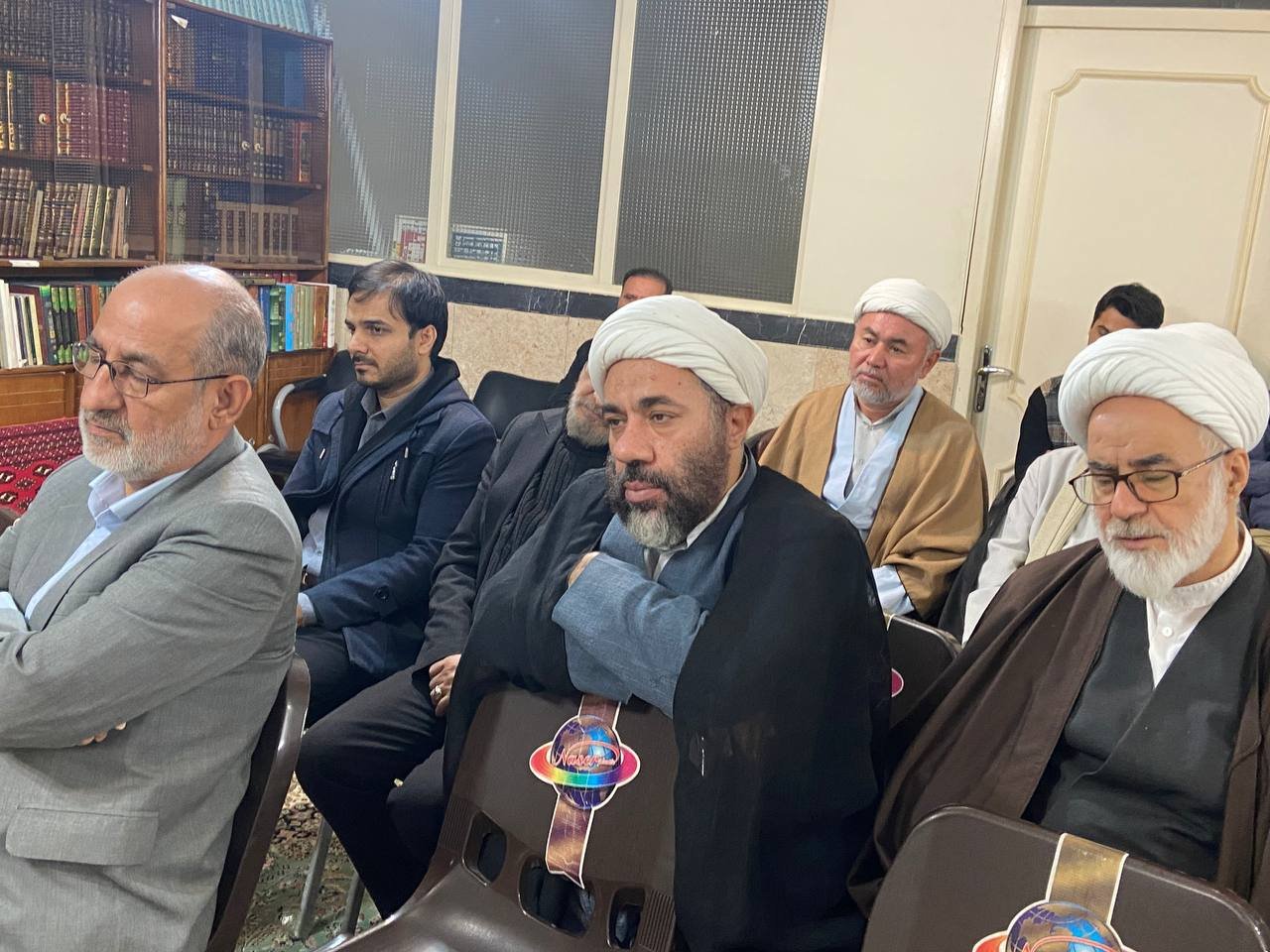
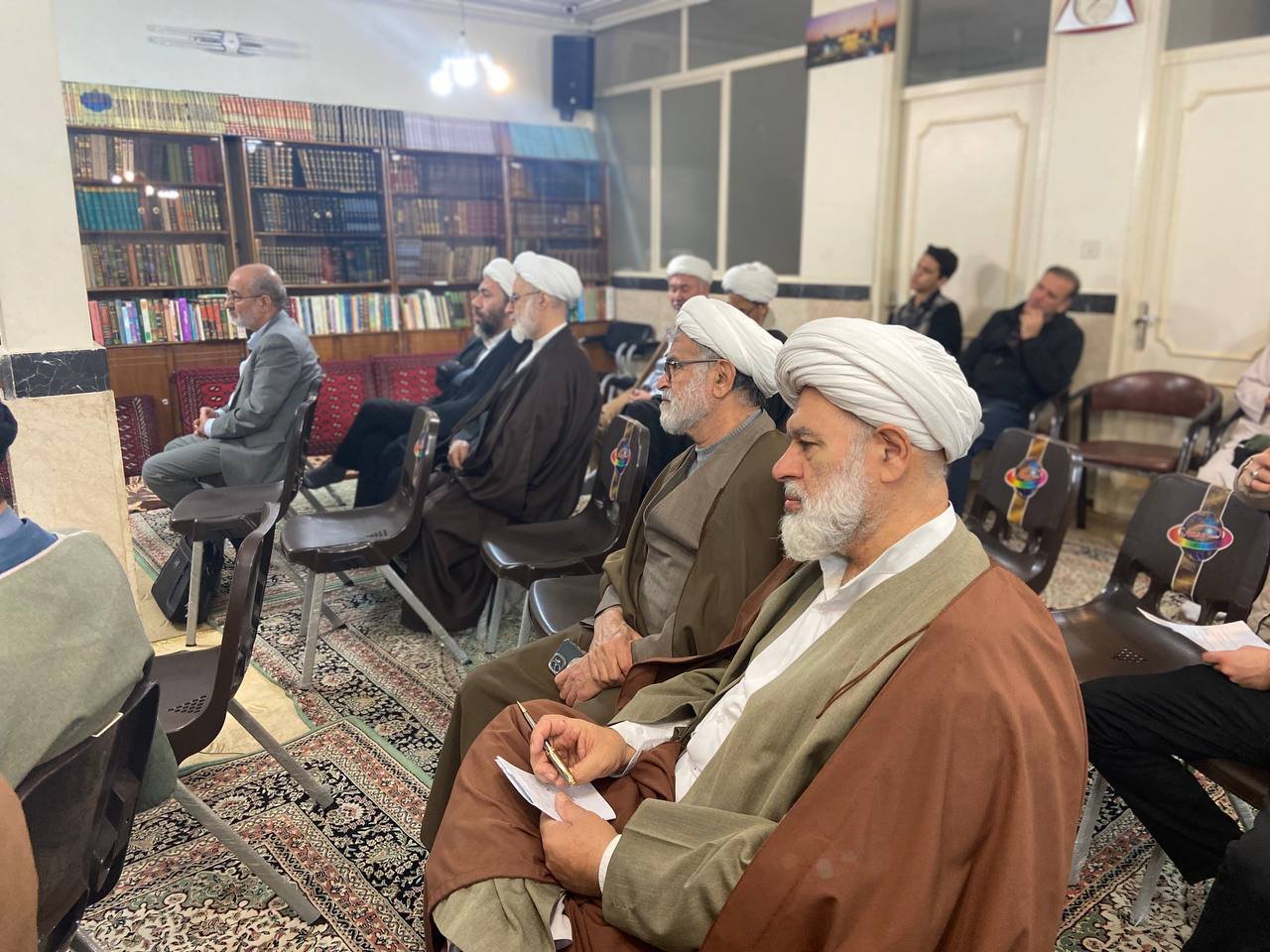
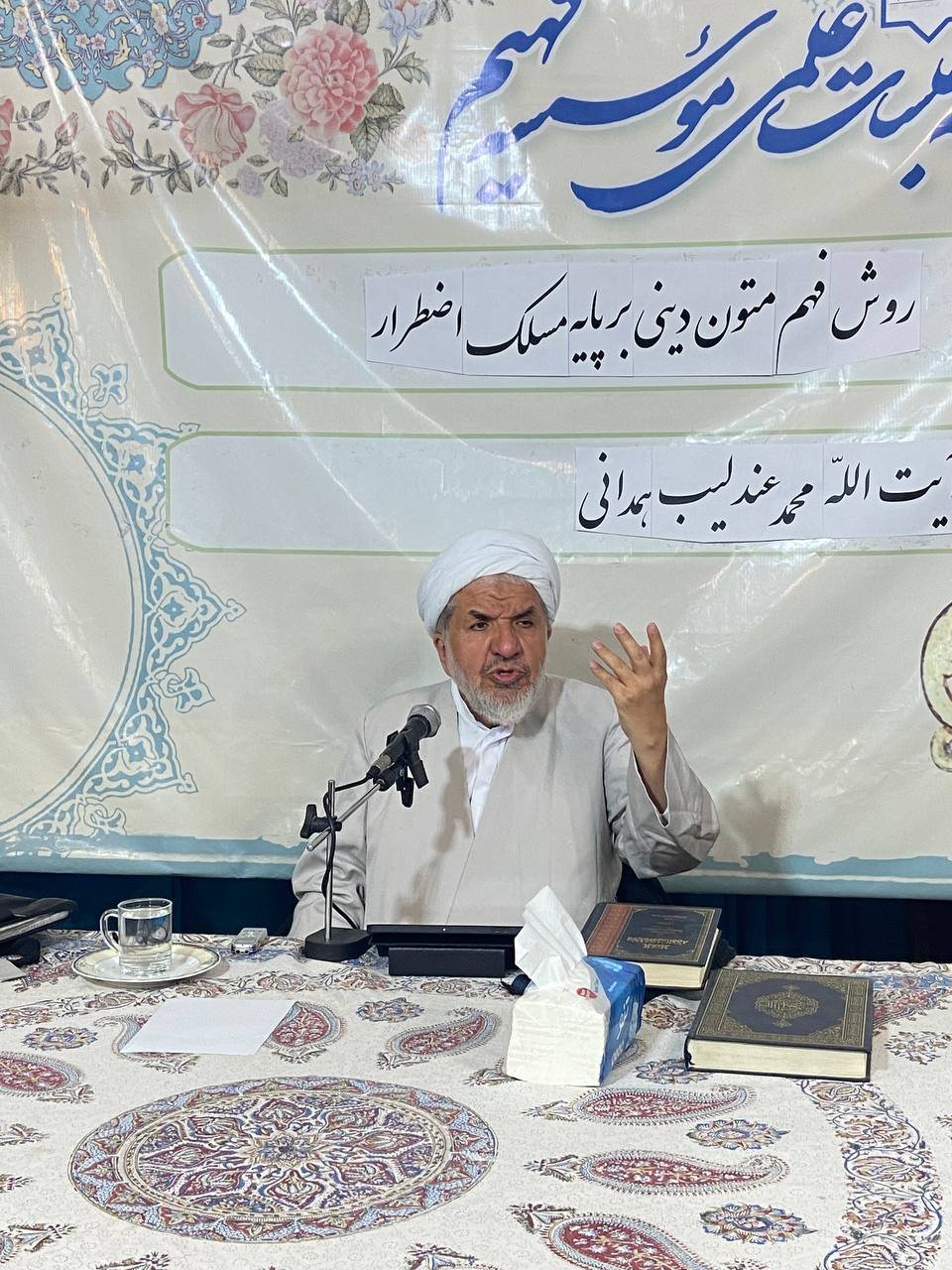
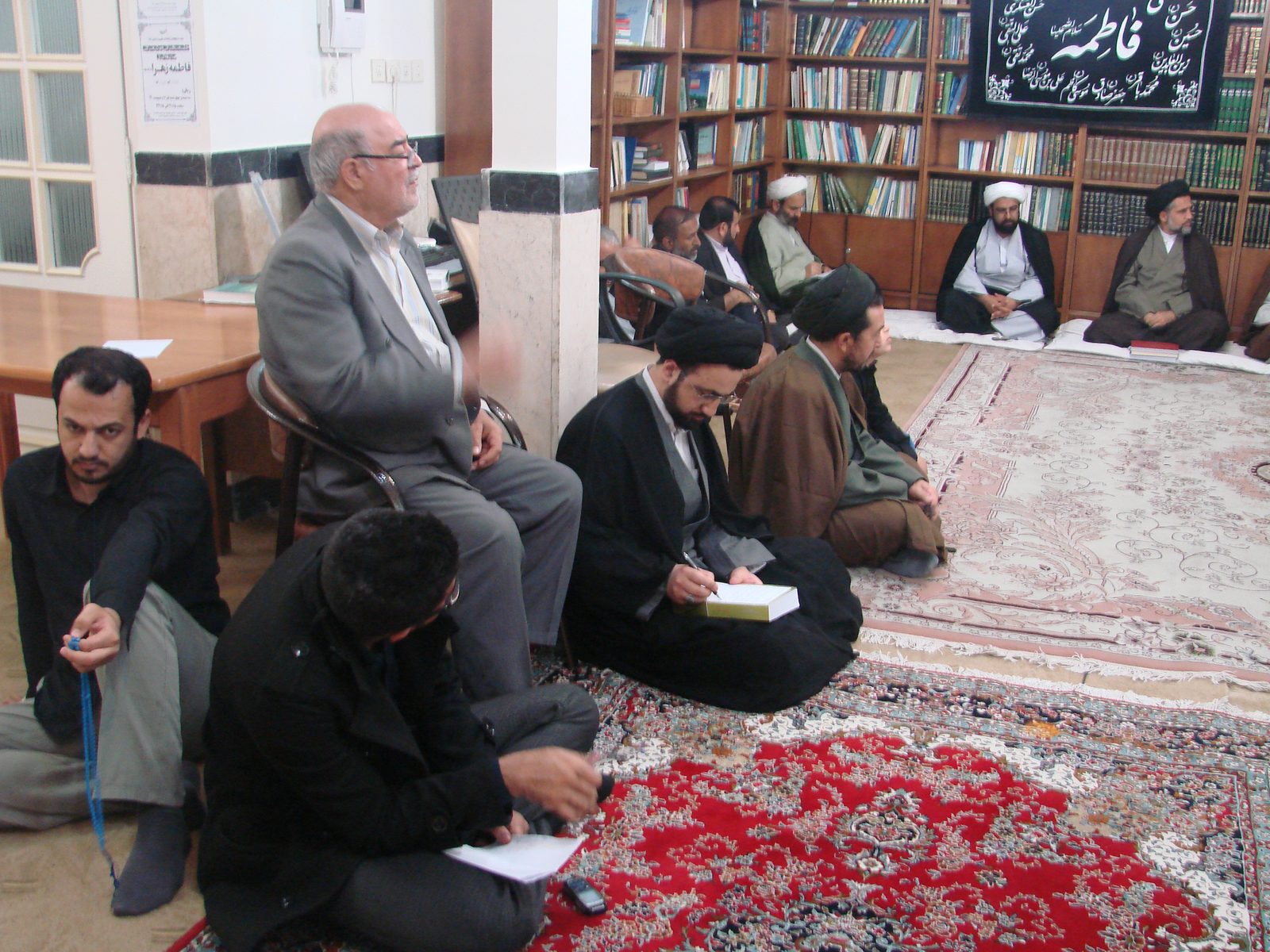
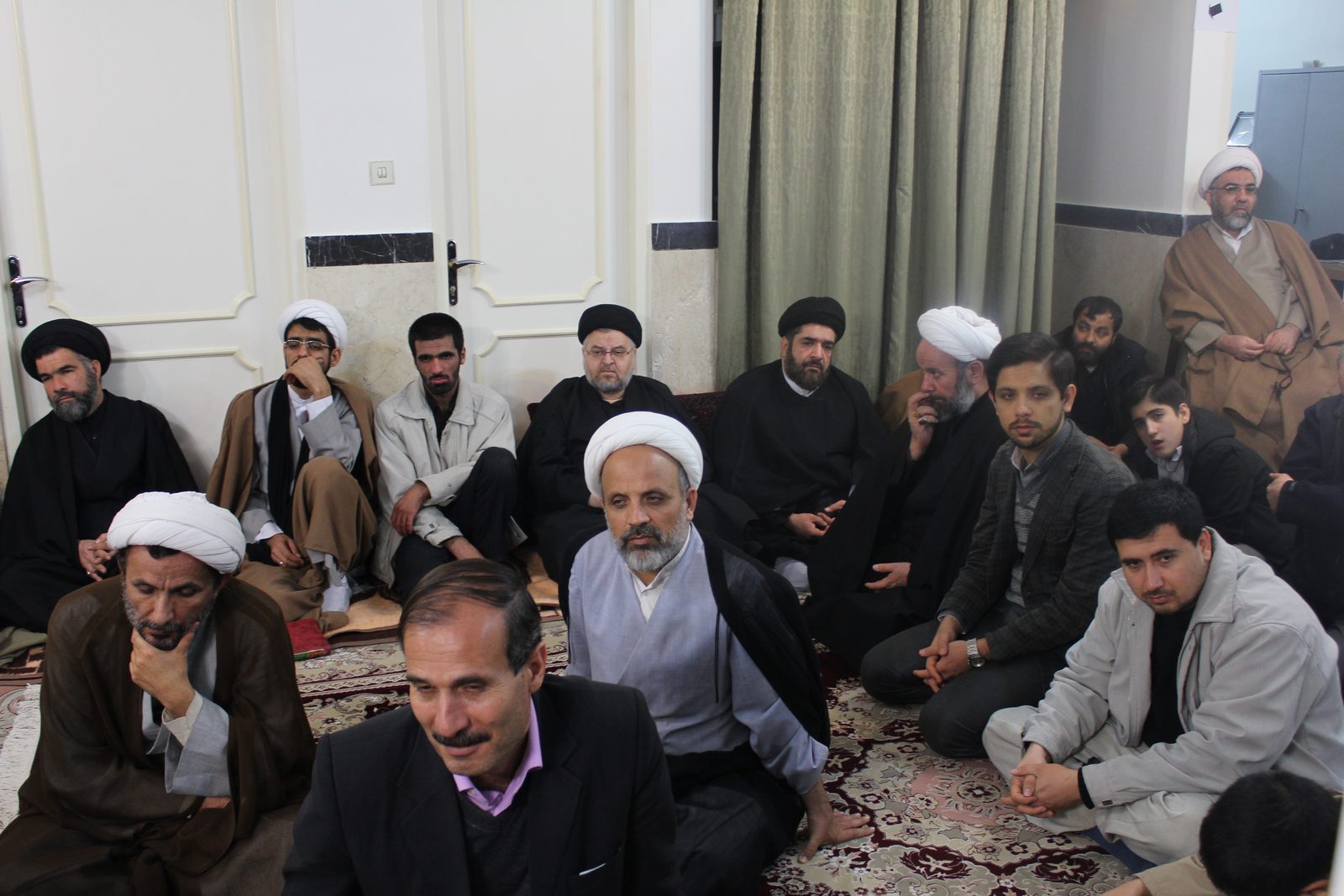
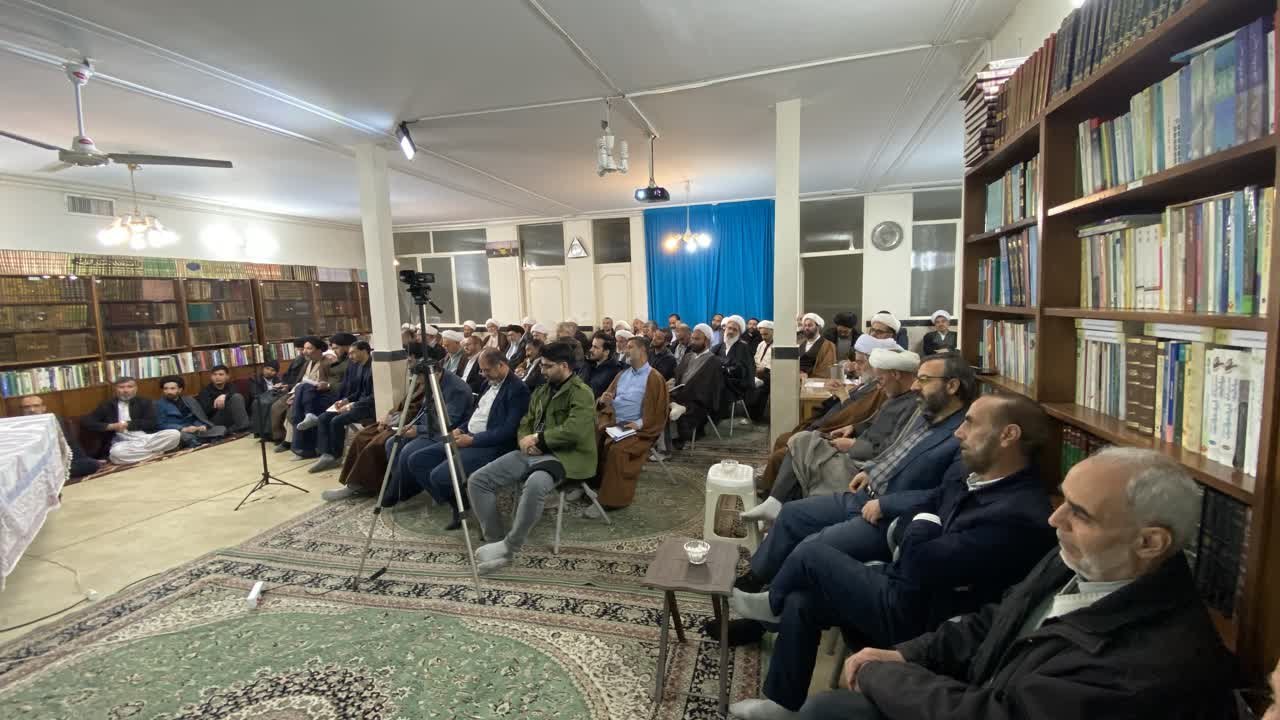
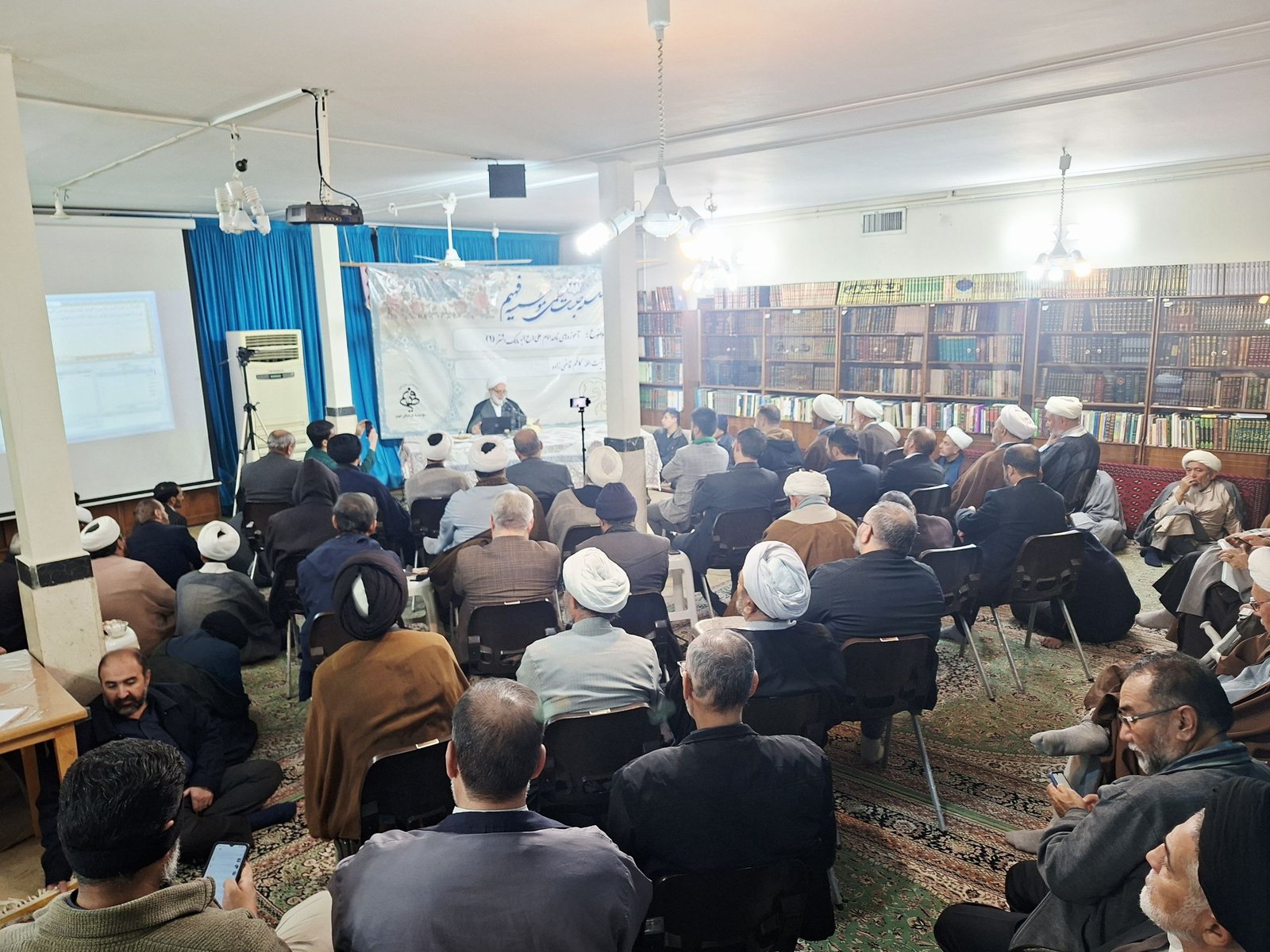
According to the Public Relations Office of the Fahim Research and Cultural Institute, the four hundred and thirty-eighth session of the Fahim Institute's series of theory-development sessions, entitled "A Method for Understanding Religious Texts Based on the Approach of Necessity (maslak al-idtirar)", was held on Thursday, 18 Dey 1404, in the presence of a group of hawza and university professors and seminary researchers, with a lecture and presentation by Ayatollah Mohammad Andalib Hamadani, one of the distinguished professors of the Qom Seminary. The full text of Professor Andalib's lecture follows:
اَلْحَمْدُ لِلّٰهِ رَبِّ الْعَالَمِينَ، بارِئِ الْخَلَائِقِ أَجْمَعِينَ، وَالصَّلَاةُ وَالسَّلَامُ عَلَىٰ سَيِّدِنَا وَسَيِّدِ أَنْبِيَاءِ الْمُرْسَلِينَ، أَبِي الْقَاسِمِ الْمُصْطَفَىٰ مُحَمَّدٍ، وَعَلَىٰ أَهْلِ بَيْتِهِ الطَّيِّبِينَ الطَّاهِرِينَ الْمَعْصُومِينَ الْمُكَرَّمِينَ، سِيَّمَا بَقِيَّةِ اللهِ الْمُنْتَظَرِ، رُوحِي وَأَرْوَاحُ الْعَالَمِينَ لَهُ الْفِدَاءُ.
Peace be upon you and the mercy of God. At the very outset, I would like to express my sincere thanks to the dear colleagues who organised this scholarly session.
The subject put forward for discussion is an examination of a theory that is neither "infitah" (the openness of the gate of knowledge), in the technical sense of usul al-fiqh, nor "insidad" (the closure of that gate). Although it bears similarities to both approaches, it also has merits of its own. In the course of the discussion it will become clear why this theory has been named "inference under necessity" (istinbat idtirari).
The main foundations on which this theory rests may be listed as follows. First, as Muslims we consider it incumbent upon ourselves to understand the text of the Qur'an and the narrations to the best of our ability. The necessity of understanding the Qur'an and the Sunnah, and likewise the necessity of observing the duties that religion has placed upon us, is clear. When He says «يَتَفَقَّهُونَ» (that they may gain understanding), it is evident that this understanding (tafaqquh) is not merely knowledge of the rulings, although it includes knowledge of the rulings as well. Tafaqquh is understanding of religion in its entirety; of course, both within the limits of one's ability and with due regard for the specialisations that are required in this field.
Second, tafaqquh in religion means attaining knowledge of the rulings and commands, so that, first, we can attribute the result to God Almighty, and second, we have a proof (hujjah) in the domain of practice.
Third, in fiqh in the specific sense of the word, our duty, as far as possible, is knowledge; and recourse to the principle of exemption (asl al-bara'ah) applies where such knowledge is not attainable.
Fourth, complete precaution (ihtiyat tamm) leads to the disruption of the social order, or at the very least causes hardship and distress ('usr wa haraj).
Fifth, what we mean by "knowledge" is not philosophical, logical or mathematical certainty. What is meant is customary knowledge; Qur'anic knowledge. The Qur'an says: «وَلَا تَقْفُ مَا لَيْسَ لَكَ بِهِ عِلْمٌ» (Do not pursue that of which you have no knowledge). This "knowledge" we sometimes also call assurance (itmi'nan), but it is knowledge. That particular logical knowledge is, in the words of the eminent scholar al-Khoei (may God be pleased with him), «عَزِيزُ الْوُجُود» (rare in existence), especially in the subsidiary matters (furu'). One cannot claim one-hundred-percent logical knowledge, and there is essentially no need to do so.
Sixth, any knowledge in this sense, if it is obtained through rational and reasonable (in the sense of the conduct of reasonable people) means not prohibited by the Shari'a, can be relied upon in attributing the result to God, and in the domain of practice it carries the force of establishing liability and excuse (munajjiziyyah and mu'adhdhiriyyah).
Seventh, "the accumulation of evidence and indications" (tajmi' al-shawahid wa al-qara'in) is one of the methods of reasonable people; not only has the Shari'a not deterred from or prohibited it, but there are numerous instances in which the Lawgiver Himself has set out this very method and the jurists have issued fatwas in accordance with it.
Eighth, there are serious challenges and quantitative and qualitative deficiencies along the path of understanding religious texts, both in fiqh in the technical sense and in fiqh in the general sense of the word. It is these very challenges that have led us to hold that there is a difference between the "revealed religion" and the "existing religion"; between the "revealed Shari'a" and the "existing Shari'a".
The approach of necessity seeks to set out emergency ways out during the period of Occultation, which is the period of the most intense trial, the peak of bewilderment, and the utmost bitterness, hardship and necessity for the Shi'a. When we call this approach that of "necessity" (idtirar), what is meant is not the necessity that stands opposite to coercion (ikrah) and belongs to the category of secondary rulings; that is not the intention. What is intended is breaking through the impasses that lie along the path of understanding religious texts, by making use of all the resources at our disposal: the resources of reasonable conduct, of reason, of transmitted sources, the opinions of experts, and other indications and evidence.
I state explicitly: knowledge and assurance that arise from rational and reasonable means, not that which is attributed to dreams, fancies and superstition; even if certainty arises for a person through unreasonable means, it still has no probative force (hujjiyyah). The author of al-Jawahir (may God elevate his station) complains in many places in "al-Jawahir" about the presence of superstition in fiqh. It is one thing when we say it; it is another when the author of al-Jawahir says it. An example of this is where he says: «أَعَاذَنَا اللهُ مِنْ أَمْثَالِ هَذِهِ الْخُرَافَاتِ» (May God protect us from the like of these superstitions).
This method of necessity manifests itself in the understanding of religious texts, both the Qur'an and the narrations; in questions of Islamic history, especially the history of the Infallibles (AS); and in the implementation of rulings. Of course, these other domains are not the subject of my discussion at present. My emphasis is rather on how effective this approach is in understanding religious texts.
That was the first point: a brief and summary account of the fundamental principles of the theory.
As for the second point: we emphasise the necessity of distinguishing between the revealed religion and what we now know by the name of religion; between the revealed fiqh and what we now know by the name of fiqh. The revealed fiqh is that which was in the sacred heart of the Seal of the Messengers and the Imams of guidance (AS); reality itself. By what argument do I establish this difference?
First, evidence is presented, on the explicit testimony of eminent scholars, that a major part of our narrative heritage has been lost to us. Second, in the existing heritage there are qualitative deficiencies: transmission by meaning, transmission by gist, fragmentation (taqti'), textual corruption (tashif), conjectural emendation in manuscripts, the loss of contextual indications, and even forgery. These clearly show the difference between the revealed religion and the existing religion. Third, the divergence of the jurists' fatwas itself indicates that we are, in a sense, faced with two "Shari'as"; otherwise disagreement of this kind would make no sense. So much so that the late Fayd Kashani (may God be pleased with him) reports in "Safinat al-Najat" that on some subsidiary questions there are as many as thirty views. Fourth, we are rightly "mukhatti'ah" (those who hold that error is possible) and do not believe in taswib (that every mujtahid's view is correct). Being mukhatti'ah means allowing for the possibility of error; that is, a gap between what is and what we have arrived at. Fifth, the discussions of the usulis on reconciling the apparent (zahiri) ruling with the actual (waqi'i) ruling are themselves evidence of the disagreement and complexity of this field. Sixth, the very basis of recourse to the practical principles (al-usul al-'amaliyyah) is that reality lies beyond our reach. Seventh, many eminent scholars in their manuals of practical law (risalah 'amaliyyah) refrain from explicit fatwas, using expressions such as «عَلَى الْأَصَحِّ» (according to the more correct view), «عَلَى الْأَشْبَهِ» (according to the more likely view), «فِيهِ تَرَدُّدٌ» (there is hesitation about it), «فِيهِ إِشْكَالٌ» (there is a difficulty in it). These show that not everything is smooth and uniform. And also the difference between "explicit text" (nass) and "apparent meaning" (zahir), and even the difference between "apparent meaning" (zuhur) and "inferred apparent meaning" (istizhar), which I will explain later.
The third point: the necessity of distinguishing between codified human laws and the narrative heritage. Sometimes in usul an example is given, "like a law", but this is only to bring the matter closer to the mind. A book of law differs from our collection of narrations.
A law is usually written and specified from the outset. Our narrations, however, except for correspondence, were mostly an oral tradition that was later written down. Even regarding correspondence there is debate, and the likelihood of taqiyyah (precautionary dissimulation) in correspondence is sometimes greater than in other narrations.
Likewise, major portions of our narrations are not in our hands, whereas this is not the case with law. Problems of manuscripts, conjectural and ijtihad-based emendations, interpolation (idraj) and the like are not seen in codified human laws.
On the other hand, the division of narrations into "ta'limiyyat" (instructional narrations) and "fatwa'iyyat" (narrations issued as rulings), which was put forward by the late Haj Mirza Mahdi Isfahani and later, in some lecture transcriptions, even by Ayatollah Sistani, has no place in the system of human legislation.
The abundance of separate indications (qara'in munfasilah), the presence of transmission by meaning and transmission by gist, the existence of governmental rulings (ahkam wila'iyyah), and even undiscovered abrogations, are all matters that set the nature of narration apart from that of law. Therefore one must distinguish between them.
The fourth point: the necessity of distinguishing, in the understanding of texts, between ordinary texts and religious texts. In understanding ordinary Arabic texts, and of course in other languages too, it is enough to observe the general logic of conversation and the specific logic of the Arabic language: apparent meanings, and then metonymy, metaphor, hyperbole, figurative usage and the like. A person may understand an Arabic text and even consult a lexicon.
In a religious text, however, whether the Qur'an or the narrations, another logic is also required. In the Qur'an, there are inner dimensions (butun) and multiple layers of meaning. In the narrations, there are allusions (ma'arid). We have it in the narrations: «لَا نَعُدُّ الرَّجُلَ فَقِيهًا حَتَّىٰ يَعْرِفَ مَعَارِيضَ كَلَامِنَا» (We do not count a man a jurist until he recognises the allusions of our speech). Allusions, equivocation (tawriyah), taqiyyah: these are things with which a jurist must be acquainted. This is my own understanding, and this last part is also close to a statement reported from His Eminence Ayatollah Sistani in "'Ilal Ikhtilaf al-Hadith".
The fifth point, which is very fundamental for me: the distinction between what is called "knowledge" ('ilm) in the Qur'an and "philosophical and logical certainty" (qat'). In books of usul, usually in the discussion of certainty, certainty is taken in the sense of one-hundred-percent philosophical certainty, anything below it is called conjecture (zann), and then the verses prohibiting conjecture are invoked. Yet this is open to dispute.
Neither is Qur'anic "knowledge" exclusively logical knowledge, nor is Qur'anic "conjecture" conjecture in the logical sense. In fact, Qur'anic conjecture mostly refers to the fancies of the Age of Ignorance (Jahiliyyah); things that have no rational or reasonable basis, such as false attributions concerning God Almighty. Conversely, if someone attains even "one-hundred-percent certainty", but through unreasonable means such as dreams, mystical unveiling (mukashafah) and superstition, the Qur'an does not place this within the sphere of proof either.
What matters is following a path that is rational, reasonable and not prohibited by the Shari'a. A number of scholars have said this, and His Eminence Ayatollah Sistani also has a detailed explanation of it in the discussion of the solitary report (khabar al-wahid) and in equilibrium and preference (al-ta'adul wa al-tarajih).
I come to the sixth point: one of the important pillars of the theory of necessity is the quantitative deficiency of the existing narrative heritage relative to the heritage that was actually issued. I will mention some evidence.
The late Wahid Behbahani has explicit statements in "al-Rasa'il al-Usuliyyah". Shaykh al-A'zam (al-Ansari) says in al-Rasa'il: «لَا يَبْعُدُ دَعْوَى الْعِلْمِ بِأَنَّ مَا خَفِيَ عَلَيْنَا مِنَ الْأَخْبَارِ وَالْقَرَائِنِ أَكْثَرُ مِمَّا ظَفِرْنَا بِهِ» (It is not far-fetched to claim knowledge that the reports and indications hidden from us are more than those we have obtained). That is, what has been lost to us of the reports and indications is more than what has reached us. Elsewhere the Shaykh again says that the loss of some narrations is the root of part of the present contradictions.
Al-Najashi, in the biographies of some narrators, speaks of the enormous volume of narrations they transmitted. It is reported of Muhammad ibn Muslim that he had thirty thousand hadiths from Imam al-Baqir (AS) and sixteen thousand from Imam al-Sadiq (AS).
Al-Najashi himself says in the introduction to his Rijal that his book is not complete, because many books were not available to him to list. Shaykh al-Tusi states explicitly in the introduction to al-Fihrist that he cannot present a catalogue of all Shi'i books, because the authors and books are scattered across the lands and many of them never reached him at all.
On the other hand, in the Shaykh's Fihrist and al-Najashi's Rijal we come across books that are named, but it is clear that even at that time they were not fully available to them, or they did not have access to all the copies. Even al-Najashi's report from Ibn 'Uqdah about certain books he had not seen bears witness to this very point.
Another example: Shaykh al-Tusi, in his biography of Shaykh al-Saduq in al-Fihrist, says that he had a book entitled "Madinat al-'Ilm" which was larger than "Man La Yahduruhu al-Faqih". It apparently existed until the time of Shaykh Baha'i's father and was then lost. Allamah Majlisi also made great efforts and did not find it.
The Shaykh himself says in the introduction to al-Tahdhib that his aim was not to collect all the Shi'i narrations, but rather to bring the narrations in which contradiction is seen in order to resolve the contradiction, and he had promised to write a book that would gather most of the narrations.
The seventh point: evidence of qualitative deficiency. Such as the discrepancies arising from the fragmentation of reports, transmission by meaning, the loss of connected indications (qara'in muttasilah), textual corruptions, as well as the difference between the usage of the Companions (of the Imams) and our usage, and also taqiyyah. The late Sayyid Yazdi too, in his commentary on al-Rasa'il, has expressions that show this qualitative deficiency.
The eighth point: the challenges of the discussion of chains of transmission (isnad). Allow me first to read a passage from Shaykh al-Ta'ifah in "al-'Uddah", so that we may also appreciate the worth of the rijal heritage and not imagine that it is worthless. Shaykh al-Tusi clearly shows that our early scholars were not lax in declaring narrators reliable or weak. They have expressions such as: so-and-so is suspect, so-and-so is a liar, so-and-so is an extremist (ghali), so-and-so is an opponent, so-and-so is a Waqifi, so-and-so is a Fathi. From these expressions it can be understood that rijal work was a serious matter for them.
Thus the Shi'i rijal heritage is, beyond doubt, among the most precious heritages of Islamic rijal. But our discussion is whether one can rely on it one hundred percent or not. As a "proof" (dalil), perhaps not; but as "evidence and indication", it is certainly worthy of consideration.
On the other hand, we should not imagine that all these reports are purely sense-based (hissi) with a connected chain. Al-Najashi and the Shaykh do not always mention a chain of transmission. Hence, in the words of the experts, there is a "minor closure" (insidad saghir) in rijal. This does not mean setting rijal aside; rather, it means that we look more carefully, seek help from other indications too, and in assessing chains of transmission do not suffice with a single criterion.
This is where I say the task is difficult. Merely opening Ayatollah al-Khoei's Rijal and saying "reliable" or "unreliable" is not complete scholarly work. Knowledge of manuscripts is necessary, knowledge of chains of transmission is necessary, knowledge of narrations is necessary, and an examination of the totality of a narrator's narrations is necessary so that we may come closer to his intellectual milieu. Then we set the indications side by side, and where there is room for reflection, we proceed with scholarly caution.
The ninth point: critique of the text (naqd al-matn). It is sometimes imagined that "critique of the text" is a new and imported term, whereas Sayyid al-Murtada himself used the very expression "critique of the text", and our eminent scholars have in practice critiqued narrations with respect to their content; such as the author of al-Hada'iq, the author of al-Jawahir, and the late Wahid Behbahani. Even narrations with authentic chains have sometimes been set aside because of a problem in their content.
Critique of the text in the approach of necessity has two motives: distinguishing proof from non-proof, and preferring one proof over another in cases of equilibrium (ta'adul) and conflict (tazahum). A narration must be measured against the Qur'an and the definitive Sunnah, as well as against the spirit of the Shari'a and its lofty objectives. Of course, this discussion requires elaboration.
The tenth point: the difference between "apparent meaning" (zuhur) and "inference of the apparent meaning" (istizhar). Zuhur is that which general custom understands from speech. Istizhar, however, is when the jurist, by arranging indications and evidence, arrives at the serious intent (al-murad al-jiddi). In the Holy Qur'an, the words, the context (siyaq), the specific logic of the Qur'an and its inner dimensions, the interpretation of the Qur'an by the Qur'an, and the related narrations, by both direct (mutabaqi) and implied (iltizami) signification, must all be taken into account. Only those narrations are set aside whose forgery is established for us; otherwise the other narrations have a "score" and take their place within the system of indications. Then the views of the exegetes are also considered.
The eleventh point: the place of reason. Here I have cited statements of eminent scholars about the value of reason and where the jurist turns to reason. For example, the author of al-Jawahir says somewhere, to a meaning close to this, that the taste of the Shari'a (madhaq al-shari'ah) is not compatible with what sound minds clearly abhor. What is meant is not raw individual reason, but sound and collective reason.
Reason has a place in inference under necessity; of course, its scope is greater in endorsed (imda'i) matters than in founding (ta'sisi) and devotional matters. In presenting this view I have also divided reason: demonstrative reason, scientific reason, usuli reason, juristic reason, collective reason; and I regard the totality of these as "juristic reasoning" (ta'aqqul faqihanah), with which the jurist must approach tafaqquh in religion.
In conclusion, I submit that the merit of the theory of inference under necessity is that it neither, like extreme Akhbarism, takes every narration as presumptively acceptable, nor, like some, sells off the narrative heritage at a bargain price. I have explicitly said many times: inference in fiqh is not possible without recourse to the extensive hadith sources. To say "most narrations have weak chains, so they should be set aside" is not correct. Narrations are either reliable, or forged, or their knowledge is to be referred to those qualified for it. A narration with a weak chain also has a "score". The accumulation of indications is not a "single proof", but when the pieces are set side by side, it can open the way.
My submission is that if we wish to offer a method commensurate with the present reality, we have no choice but to arrive at the accumulation of evidence, a holistic view and scoring. Neither excess in rejection nor excess in acceptance.
Finally, I apologise if this was lengthy; I also omitted a great deal so that the discussion would be concise. My whole pride is that I am a reciter of elegies (rawdah) and the son of a reciter of elegies. Tonight, being the eve of Friday in the month of Rajab, I offer a salutation to the Master of Martyrs, Imam al-Husayn (AS):
اَلسَّلَامُ عَلَيْكَ يَا أَبَا عَبْدِ اللهِ، وَعَلَى الْأَرْوَاحِ الَّتِي حَلَّتْ بِفِنَائِكَ. عَلَيْكَ مِنِّي سَلَامُ اللهِ أَبَدًا مَا بَقِيتُ وَبَقِيَ اللَّيْلُ وَالنَّهَارُ، وَلَا جَعَلَهُ اللهُ آخِرَ الْعَهْدِ مِنِّي لِزِيَارَتِكَ. اَلسَّلَامُ عَلَى الْحُسَيْنِ، وَعَلَى عَلِيِّ بْنِ الْحُسَيْنِ، وَعَلَى أَوْلَادِ الْحُسَيْنِ، وَعَلَى أَصْحَابِ الْحُسَيْنِ. وَالسَّلَامُ عَلَيْكُمْ وَرَحْمَةُ اللهِ وَبَرَكَاتُهُ.
Comments
No comments yet. Be the first.
Write a note, critique or commentShare your view with us and other readers without leaving this page.