


بِسْمِ اللَّهِ الرَّحْمَنِ الرَّحِيمِ
الْحَمْدُ لِلَّهِ رَبِّ الْعَالَمِينَ، بَارِئِ الْخَلَائِقِ أَجْمَعِينَ، بَاعِثِ الْأَنْبِيَاءِ وَ الْمُرْسَلِينَ، وَ الصَّلَاةُ وَ السَّلَامُ عَلَى سَيِّدِنَا وَ نَبِيِّنَا أَبِي الْقَاسِمِ الْمُصْطَفَى مُحَمَّدٍ، وَ عَلَى أَهْلِ بَيْتِهِ الطَّيِّبِينَ الطَّاهِرِينَ الْمَعْصُومِينَ، وَ أَصْحَابِهِ الْمُنْتَجَبِينَ. رَبِّ اشْرَحْ لِي صَدْرِي وَ يَسِّرْ لِي أَمْرِي وَ احْلُلْ عُقْدَةً مِنْ لِسَانِي يَفْقَهُوا قَوْلِي.
Introduction and Statement of the Topic
I offer my condolences on these days of calamity and mourning for the Household of the Prophethood: the passing of the Noble Prophet of Islam (PBUH), the martyrdom of Imam al-Mujtaba (AS), and these nights, which are the nights of the martyrdom of our benefactor, Imam al-Rida (AS).
Today, somewhere, a dear friend said from the pulpit that the great scholars have advised that during these days one should only recite elegies (rawdah), and that talking should be left for other times. It seems, however, that I have been invited by mistake! For if I were to act on that gentleman's principle, at most I could briefly trouble you with some seminary-style remarks and discussions of this kind. I apologise in advance to all the professors and the esteemed audience, and I hope that God Almighty will cause beneficial words to flow through my mind and tongue.
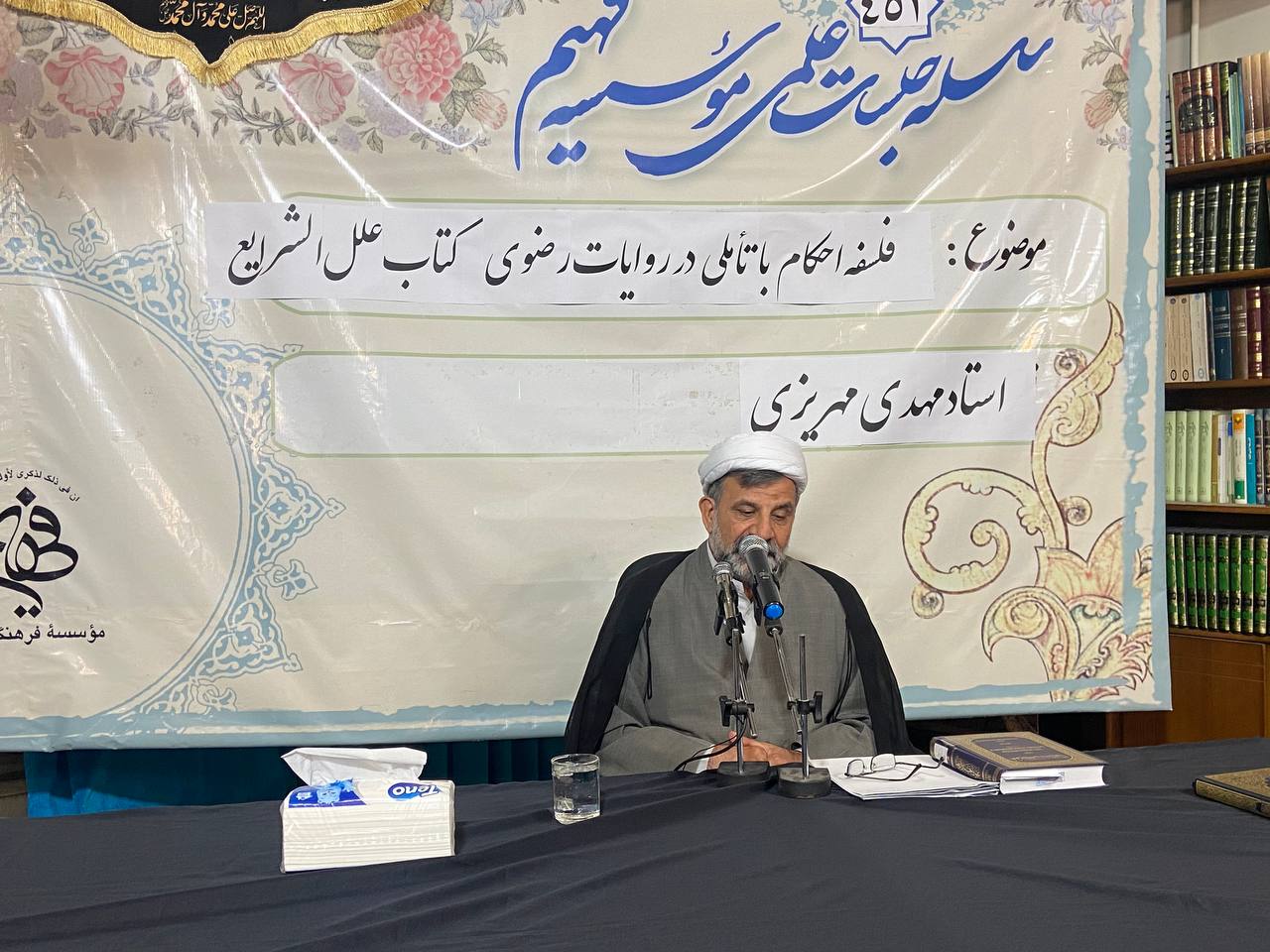
The topic I had in mind, and on which I was keen for us to reflect together, is “the narrations of Imam al-Rida (AS) on the reasons (‘ilal) of rulings”. Regrettably, the narrations on reasons are among those important parts of Shi‘i teachings that receive little attention and are seldom the focus of scholarly and seminary discussions. Within these narrations lie both abundant epistemic discussions and discussions that can open the way in fiqh and in our juristic inferences; yet unfortunately they have remained neglected. My motivation is that perhaps the door to these discussions may be opened in the circles of the hawza, and more serious reflections on them may be undertaken by experts and professors.
My approach on this occasion, however, is not to address the ijtihad-related aspects and the question of “what place the cause (‘illah) and the wisdom (hikmah) have in inference”; although today, in juristic discussions, attention to the objectives of the Shari‘a (maqasid al-shari‘a) and the reasons of rulings for inference is a very extensive discussion. My approach here is rather hadith-oriented and concerned with “fiqh al-hadith” (the understanding of hadith); for these narrations have a far wider scope and also encompass doctrinal, historical and theological dimensions.
The Unparalleled Role of Shaykh al-Saduq and the Challenge of the Fragmentation of Narrations
The late Shaykh al-Saduq (may God be pleased with him) carried out one of the most beautiful and intelligent works in attending to this section of the narrations. Although in classifications he is counted among the hadith scholars, he was truly a worldly-wise hadith scholar; someone who made numerous journeys, saw various lands (including in Central Asia) and associated with many thinkers. For this reason, he is, in all fairness, pre-eminent in the choice of titles and the arrangement of books into chapters
.
His masterpiece in this field is the noble book «عِلَلُ الشَّرَائِع» ('Ilal al-Shara'i'), in which some one thousand five hundred narrations on the reasons for rulings and phenomena have been collected. He also included another portion of such narrations in the valuable book «عُيُونُ أَخْبَارِ الرِّضَا (علیهالسلام)» ('Uyun Akhbar al-Rida) (especially in the chapters concerning reasons, namely chapters thirty-two, thirty-three and thirty-four). These three chapters are of great importance:
- Part of them consists of narrations transmitted by Muhammad ibn Sinan.
- Another part consists of narrations reported by al-Fadl ibn Shadhan.
- Chapter thirty-two, moreover, is devoted to miscellaneous reasons.
The noteworthy and highly attractive point about these chapters is that they are continuous collections of narrations and have not been “fragmented” (taqti‘). We know that fragmentation is a great bane to the understanding of our narrations. When the late Grand Ayatollah Burujirdi (may God elevate his noble station) ordered the compilation of the book Jami‘ Ahadith al-Shi‘a, one of his main concerns was to remedy precisely this bane of the numerous fragmentations made by the author of al-Wasa'il.
In my view, however, we face a greater challenge, namely “fragmentation before the compilation of the Four Books”; a fragmentation for which hardly anyone has thought of seeking a remedy. We have few texts that present the words of the Prophet (PBUH) or the Imams (AS) in an integral form (although there are exceptions such as Nahj al-Balagha, al-Sahifa al-Sajjadiyya or certain letters). The aforementioned chapters in 'Uyun Akhbar al-Rida are of the same kind of continuous and untouched texts.
In many of our hadith books, narrations have become like proverbs; that is, we have two lines of chain of transmission and only one line of text (for example about patience or asceticism). In the process, the context in which the words were issued, and what preceded and followed them, is lost. But in the continuous narrations of al-'Uyun, these benefits have not been lost.
The Fruits of Deep Reflection on the Narrations on Reasons
If we wish to look systematically at the rationale for engaging with these narrations, five fundamental benefits can be envisaged:
- Displaying the rationality of religious teachings: These narrations prove that religious rulings are not purely devotional matters that cannot be thought about. The Holy Lawgiver offers explanation and clarification both in purely devotional matters and in non-devotional ones.
- The door of question and answer being open: They show how broad-mindedly the Imams (AS) answered questions.
- Providing the ground for thinking and reasoning: Stating the reason stimulates the mind of the addressee to dynamism.
- Institutionalising the culture of dialogue in the community of believers.
- Enlightenment and persuasion: They bring religious belief to the stage of inner conviction.
Here I must point to a common fallacy; sometimes certain professors and intellectuals (and even Mr. Malekian in some instances) fall into the error of saying: “Since religion is a devotional matter, reason has no place in it!”
This is a great error. The opposite of reasoning is not “devotional submission” (ta‘abbud) but “blind prejudice” (ta‘assub). Religious devotional submission in no way means blind prejudice and is entirely compatible with reasoning. That is, the All-Wise Lord has given a command and at the same time has left open the way to thinking, reflecting, dialogue and discussion about it.
For instance, Western critics find fault with the story of Prophet Abraham (AS) in the Qur'an and regard it as the symbol of pure devotional submission (read: blind obedience); whereas the Qur'an relates three central stories of Abraham (AS), two of which are entirely based on argument and reasoning!
One is the story of the revival of the birds, in which Abraham himself says: «لِيَطْمَئِنَّ قَلْبِي» (that my heart may be at rest, i.e. I wish to attain rational and intuitive certainty). The other is his unparalleled debate with the tyrant of his time (Nimrod) about the rising and setting of the sun, which is argument from beginning to end. Yes, there is also the story of the sacrifice of Ishmael, which is the pinnacle of submission; but one must not ignore those two great rational dimensions and attribute everything to pure devotional submission.
Five Glimpses of Pure Teachings in the Mirror of the Reasons
Allow me, from among the hundreds of narrations in these two books ('Ilal al-Shara'i' and 'Uyun Akhbar al-Rida), to point to five fascinating examples (juristic and doctrinal):
First Glimpse: The Difference Between Making Up Prayer and Fasting for Women
Why must women make up the fasts missed during their menstrual period, while making up the prayers is not obligatory for them?
In the fragmented narrations (such as the narrations of Aban ibn Taghlib in the chapter on the invalidity of analogy), when Abu Hanifa wishes to employ analogy, Imam al-Sadiq (AS) says:
«فَمَا بَالُ الْحَائِضِ تَقْضِي الصِّيَامَ وَ لَا تَقْضِي الصَّلَاةَ؟ كَيْفَ يَقُومُ لَكَ الْقِيَاسُ؟» (Then why does a menstruating woman make up the fast but not the prayer? Religion is not compatible with analogy.)
The apparent meaning of such narrations is that this difference is a purely devotional secret which we do not understand. But when we refer to the narrations of al-Fadl ibn Shadhan in 'Uyun Akhbar al-Rida, Imam al-Rida (AS) analyses the matter in a very subtle and rational manner:
«فَمِنْهَا أَنَّ الصِّيَامَ لَا يَمْنَعُهَا مِنْ خِدْمَةِ نَفْسِهَا وَ خِدْمَةِ زَوْجِهَا وَ إِصْلَاحِ بَيْتِهَا وَ الْقِيَامِ بِأُمُورِهَا وَ الِاشْتِغَالِ بِمَرَمَّةِ مَعِيشَتِهَا، وَ الصَّلَاةُ تَمْنَعُهَا مِنْ ذَلِكَ كُلِّهِ... لِأَنَّ الصَّلَاةَ فِي الْيَوْمِ وَ اللَّيْلَةِ مِرَارٌ...»
The Imam says that fasting does not prevent a woman from attending to the affairs of life, her family and her rest (it is merely refraining from eating and drinking, and the limbs of the body are not engaged). But the daily prayers are recurrent and require the engagement of the limbs. If a woman were to make up all the prayers of these days (say, ten days) during her days of purity, she would be cut off from the entire normal course of life. This shows the Shari‘a's attention to human capacity and to ease in religion; an explanation that is entirely reasonable and pleasing
Second Glimpse: The Criterion of the Legal Travel Distance (Eight Farsakhs)
In the narrations of al-Fadl ibn Shadhan the question is asked:
«فَلِمَ وَجَبَ التَّقْصِيرُ فِي ثَمَانِيَةِ فَرَاسِخَ لا أَقَلَّ مِنْ ذَلِكَ وَ لا أَكْثَرَ؟» (Why is it exactly eight farsakhs that is the criterion for shortening the prayer?)
The Imam says:
«لِأَنَّ ثَمَانِيَةَ فَرَاسِخَ مَسِيرَةُ يَوْمٍ لِلْعَامَّةِ وَ الْقَوَافِلِ...» (Because eight farsakhs was exactly the distance travelled in one day by the caravans and ordinary people of that time.)
This reasoning deserves much reflection in our present-day juristic inferences. When the criterion is “covering the distance of one day's journey”, does the same ruling still apply in the same way today, when by aeroplane or fast car we cover hundreds of kilometres in a few hours? These are among the blessings of the narrations on reasons, which open new horizons for jurisprudence (fiqahah).
Third Glimpse: The Substitution of Fasting for Expiation
The question is asked: if someone is unable to free a slave as expiation (kaffarah), why does his obligation shift to “fasting”, and not, for example, to “performing the Hajj” or “praying”?
«فَلِمَ وَجَبَتِ الْكَفَّارَةُ عَلَى مَنْ لَمْ يَجِدْ تَحْرِيرَ رَقَبَةٍ الصِّيَامُ دُونَ الْحَجِّ وَ الصَّلَاةِ وَ غَيْرِهِمَا؟»
The Imam's answer is exactly like the reason given for women making up their fasts:
«لِأَنَّ الصَّلَاةَ وَ الْحَجَّ وَ غَيْرَهُمَا مِنَ الْفَرَائِضِ مَانِعَةٌ لِلْإِنْسَانِ مِنَ التَّقَلُّبِ فِي أَمْرِ دُنْيَاهُ وَ مَصْلَحَةِ مَعِيشَتِهِ...»
Performing the Hajj or lengthy prayers keeps a person from work and from attending to his livelihood; but fasting is compatible with daily work and does not disrupt the order of the person's life.
Fourth Glimpse: The Secret of Not Reclaiming Fadak
Imam al-Rida (AS) was asked:
«لِمَ لَمْ يَسْتَرْجِعْ فَدَكَ لَمَّا وَلِيَ أَمْرَ النَّاسِ؟» (Why did the Commander of the Faithful not take back Fadak when he came to power, even though he had previously pursued it?)
The Imam's answer is a fundamental principle of Islamic governance. He says:
«لِأَنَّنَا أَهْلُ بَيْتٍ لَا يَأْخُذُ لَنَا حُقُوقَنَا مِمَّنْ ظَلَمَنَا إِلَّا اللَّهُ عَزَّ وَ جَلَّ، وَ نَحْنُ أَوْلِيَاءُ الْمُؤْمِنِينَ إِنَّمَا نَحْكُمُ لَهُمْ وَ نَأْخُذُ لَهُمْ حُقُوقَهُمْ مِمَّنْ ظَلَمَهُمْ وَ لَا نَأْخُذُ لِأَنْفُسِنَا.»
When we, the Ahl al-Bayt, come to power, we no longer pursue personal claims, the settling of past scores, or our own partisan and family interests. We are the guardians of the people and we reclaim their usurped rights, but our own personal right we leave to God. This is the pinnacle of purity in politics.
Fifth Glimpse: Why Two Imams Do Not Coexist at One Time
Why does God not place two Imams together in the office of active Imamate at one time?
«لِمَ لَا يَجُوزُ أَنْ يَكُونَ فِي الْأَرْضِ إِمَامَانِ فِي وَقْتٍ وَاحِدٍ؟»
The Imam says:
«إِنَّ الْوَاحِدَ لَا يَخْتَلِفُ فِعْلُهُ وَ تَدْبِيرُهُ، وَ الِاثْنَيْنِ لَا يَتَّفِقُ فِعْلُهُمَا وَ تَدْبِيرُهُمَا...»
The wills, the policies and the manner of action of human beings differ, even if both are infallible. We read in Ziyarat al-Jami‘a al-Kabira that the Imams are one at the level of luminosity before creation (أَنَّ أَرْوَاحَكُمْ وَ نُورَكُمْ وَ طِينَتَكُمْ وَاحِدَةٌ), but when they come into this world of multiplicity they become multiple and different.
The Qur'an says to the Noble Prophet (PBUH):
«فَاصْبِرْ كَمَا صَبَرَ أُولُوا الْعَزْمِ مِنَ الرُّسُلِ» (Be patient, as the messengers of firm resolve were patient), and elsewhere it says: «وَ لَا تَكُنْ كَصَاحِبِ الْحُوتِ» (And do not be like the companion of the fish, i.e. Jonah, whose patience quickly ran out).
The prophets differed from one another; one (Noah) was patient for nine hundred and fifty years and did not curse, while another (Jonah) became impatient much sooner. One (Jacob) wept for years in grief at separation from his son until he became blind, while another (Abraham), at the height of old age, took his beloved son to the place of sacrifice with his own hands.
In al-Baladhuri's Ansab al-Ashraf there is a remarkable report: when, after the martyrdom of Imam Hasan (AS), a group of revolutionary Shi‘as wrote to Imam Husayn (AS) urging him to rise up, he replied:
«إِنِّي لَأَرْجُو أَنْ يَكُونَ رَأْيُ أَخِي رَحِمَهُ اللَّهُ فِي الْمُوَادَعَةِ، وَ رَأْيِي فِي جِهَادِ الظَّلَمَةِ رَشَداً وَ سَدَاداً... فَالْصَقُوا بِالْأَرْضِ...»
(I hope that the view of my brother Hasan regarding peace, and my view regarding jihad against the oppressors, will both be a source of right guidance and soundness... For now, stay in your homes.)
This means the difference of two approaches and two policies! If we are only idealists, we become deluded people living in the clouds; and if we are only realists, we will become comfort-seeking people concerned with our own ease. The Shi‘i way of life is the interplay of “ideal” and “reality”. The reality of society has four pillars: the differences between leaders, the differences in people's capacity, inescapable natural conditions, and conditions imposed by enemies.
May God have mercy on the late Professor Musavi-Nejad; in the period before the Revolution (the years fifty-five to fifty-seven), he would often recite this noble hadith of Usul al-Kafi in his ethics lessons:
«الْحَسَنُ وَ الْحُسَيْنُ إِمَامَانِ قَامَا أَوْ قَعَدَا»
An Imam is an Imam, whether he rises up with the sword or, for a higher interest, refrains from rising.
The Pilgrim of Tus and a Turn to the Elegy of al-Baqi‘
The late Shaykh al-Saduq writes in the introduction to the book «عيون أخبار الرضا» ('Uyun Akhbar al-Rida) that the reason for composing this book was that al-Sahib ibn ‘Abbad (the Shi‘i and learned vizier of the Buyids) sent him two verses of poetry in praise of Imam al-Rida (AS), and he wished to present him with a gift of equal worth.
The poems of al-Sahib ibn ‘Abbad are a burning testament of devotion; poetry that has welled up from the depths of the soul of a lover immersed in wilayah. Addressing the pilgrims to Mashhad, he says:
يَا سَائِراً زَائِراً إِلَى طُوسِ
مَشْهَدِ طُهْرٍ وَ أَرْضِ تَقْدِيسِ
(O you who are setting out for Tus, that pure shrine and holy land...)
أَبْلِغْ سَلَامِي الرِّضَا وَ حُطَّ عَلَى
أَكْرَمِ رَمْسٍ لِخَيْرِ مَرْمُوسِ
(Convey the greetings of restless me to Imam al-Rida, and alight at that noble threshold of the best of those laid in the grave...)
وَ اللَّهِ وَ اللَّهِ حَلْفَةٌ صَدَرَتْ
مِنْ مُخْلِصٍ فِي الْوَلَاءِ مَغْمُوسِ
(By God! By God! This is the lament rising from the breast of a servant immersed in your wilayah...)
إِنِّي لَوْ كُنْتُ مَالِكَاً أَرَبِي
كَانَتْ بِطُوسٍ الفِنَا وَ تَعْرِيسِي
(Were I master of my own affairs and free of the entanglements of the age, I would take up my whole life, my household and my kin and settle as a neighbour of Tus...)
My master! The world laughs at me... Our troubles and our estrangement are many. You yourself know the pain of estrangement, O Ali ibn Musa al-Rida...
السلام علیک یا غریب الغربا...
Let us go into the courtyard and sanctuary of our master Ali ibn Musa al-Rida...
The Proof of God lay upon the dust inside a locked chamber... writhing like one bitten by a snake...
The heavens lay beneath your wings, yet you fell to the ground!
The sustenance of a whole world came from your door, yet you fell to the ground!
If you saw him draw his cloak over his head... know that the treacherous one had done his work...
Your voice reached no one's ear that day...
No one was around you, and you fell to the ground...
Your face covered in dust, your turban and cloak covered in dust...
Your mother was before your eyes, and you fell to the ground...
It is as if the elegies of you, the Ahl al-Bayt, are everywhere bound up with the elegies of your mother...
The poison, my master, sought your very liver from your being...
A fire was upon your liver, and you fell to the ground...
Imam al-Rida was moaning, and al-Jawad, the Imam, was striking his own head...
Tears were in your moist eyes, and you fell to the ground...
From this very place, where you have taken your heart into the courtyard and sanctuary of Ali ibn Musa al-Rida and wept for your Imam in tranquillity, I want to take your hearts somewhere else... to take hearts to Medina...
Do you know why pilgrims at the shrine of Imam al-Rida perform their pilgrimage in such tranquillity? But the air of Medina... the air of al-Baqi‘...
On a day like today (the day of the martyrdom of Imam al-Mujtaba), they do not let you weep freely beside al-Baqi‘! Alas...
From right here we become your pilgrims, dear Hasan... From right here we weep aloud for you... God willing, may Medina be granted to all of us this year.
Go and stand beside those four dusty, forsaken graves, place your hand on your chest and offer your greetings...
السَّلَامُ عَلَيْكُمْ أَئِمَّةَ الْهُدَى... السَّلَامُ عَلَيْكُمْ أَهْلَ النَّجْوَى... السَّلَامُ عَلَيْكُمْ يَا حُجَجَ اللَّهِ عَلَى أَهْلِ الدُّنْيَا...
Whenever you look at these four forsaken graves, you cannot hold back your tears; again and again you strike your chest with your fist and say: may I be sacrificed for your estrangement, O Ahl al-Bayt...
My dear Hasan... may I be sacrificed for your estrangement, my master...
At your name the chest-beaters are stirred with zeal...
At your name every mourning gathering is overwhelmed, my dear Hasan...
Who says you are without anyone and have no shrine? Master, you have a shrine in our hearts...
Everyone says you are very much your mother's son; for since the alleys of Banu Hashim... since that very childhood... you have kept your fist clenched for a lifetime...
I myself saw my mother... in the middle of the alley... the murderer, now in the alley and now in the house...
May the Sayyids forgive me... they darkened your mother's day right there... they raised the sheath of the sword...
On a day like today, his accursed wife poured the poison into his mouth... the torn pieces of Imam al-Mujtaba's liver poured into a basin...
My dear Hasan... now there is a basin before you... the house of hearts is reciting an elegy...
Before Zaynab's gaze, your lips are drenched in blood...
لا اله الا الله...
The ruby of your bloodied lips becomes your sister's torment...
O God! Here they placed a basin before Zaynab... and another basin in Damascus...
Here, one basin saw the torn pieces of a brother's liver... and another basin in Damascus saw a brother's severed head, whose lips and teeth the drunken Yazid struck with a bamboo cane...
The lamenting cry of Fatimah rose up: يا أَبَتَاهْ، يَا رَسُولَ اللَّهِ...
They brought the brother's body towards the Mosque of the Prophet... they wished to bury him beside the luminous grave of the Prophet... the treacherous ones prevented it... ‘A'isha mounted a mule and said: I will not allow it... Alas...
Go back to al-Baqi‘... bury him in that very cemetery of al-Baqi‘...
The ignoble one gave the order: shower the body with arrows!
All the arrows struck his pure body... before the eyes of his brother Husayn... may I be sacrificed for the grief of Aba Abdillah's heart...
He sat down in the cemetery of al-Baqi‘, drew out these arrows one by one from his brother's body, and shed tears...
He said: «لَيْسَ الْمُصَابُ مَنْ أُصِيبَ بِمَالِهِ، إِنَّمَا الْمُصَابُ مَنْ أُصِيبَ بِأَحِبَّتِهِ»
The one who is truly bereaved is not the one whose property has been taken; the bereaved one is I, dear Hasan! For I have lost a brother like you...
وَ سَيَعْلَمُ الَّذِينَ ظَلَمُوا أَيَّ مُنْقَلَبٍ يَنْقَلِبُونَ، رَحِمَ اللَّهُ مَنْ نَادَى يَا حُسَيْن...
السَّلَامُ عَلَى الْحُسَيْنِ وَ عَلَى عَلِيِّ بْنِ الْحُسَيْنِ وَ عَلَى أَوْلَادِ الْحُسَيْنِ وَ عَلَى أَصْحَابِ الْحُسَيْنِ...
Closing Supplication
اللهم عَجِّل لِوَلِیِّک الفَرَج...
O God! Make the precious heart of His Holiness Baqiyyat Allah (may our souls be his ransom) pleased and content with us.
Grant all of us success in abandoning sin and disobedience.
Bestow upon us sincere tears, ardour and lament at the house of the Ahl al-Bayt.
Bring the steps of this mourning gathering, this very year, to the cemetery of al-Baqi‘ and beside the luminous resting place of the Prophet and the Imams of guidance.
O God! Grant swift healing to all the sick.
Grant honour and victory to the front of Islam and the Resistance.
Convey a reward from this gathering of supplication to the souls of all the departed, the deceased of this gathering, and the honourable sponsors.
بِالنَّبِيِّ وَ آلِهِ، صَلَوَاتُ اللَّهِ عَلَيْهِمْ أَجْمَعِينَ.
Comments
No comments yet. Be the first.
Write a note, critique or commentShare your view with us and other readers without leaving this page.