


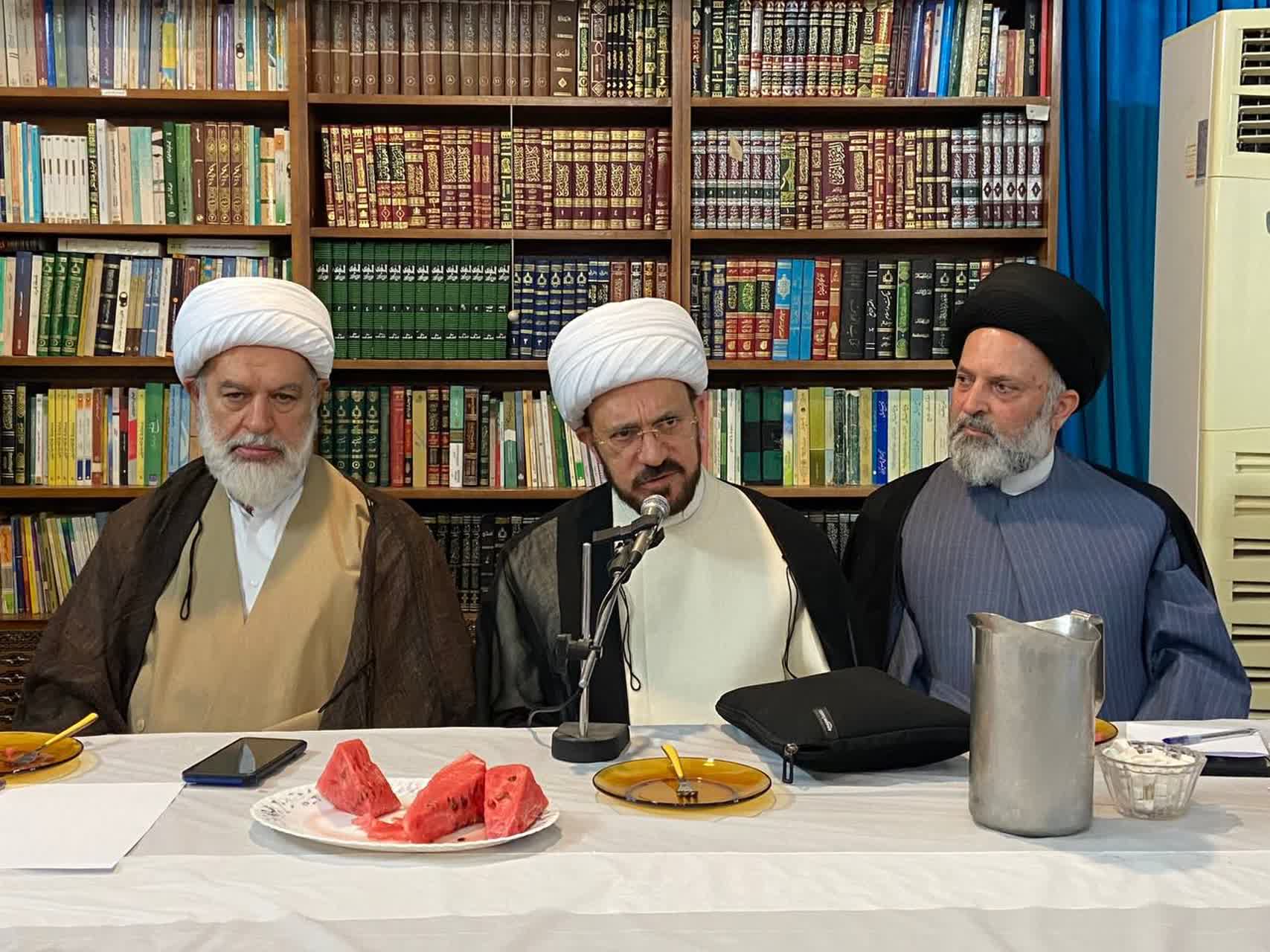
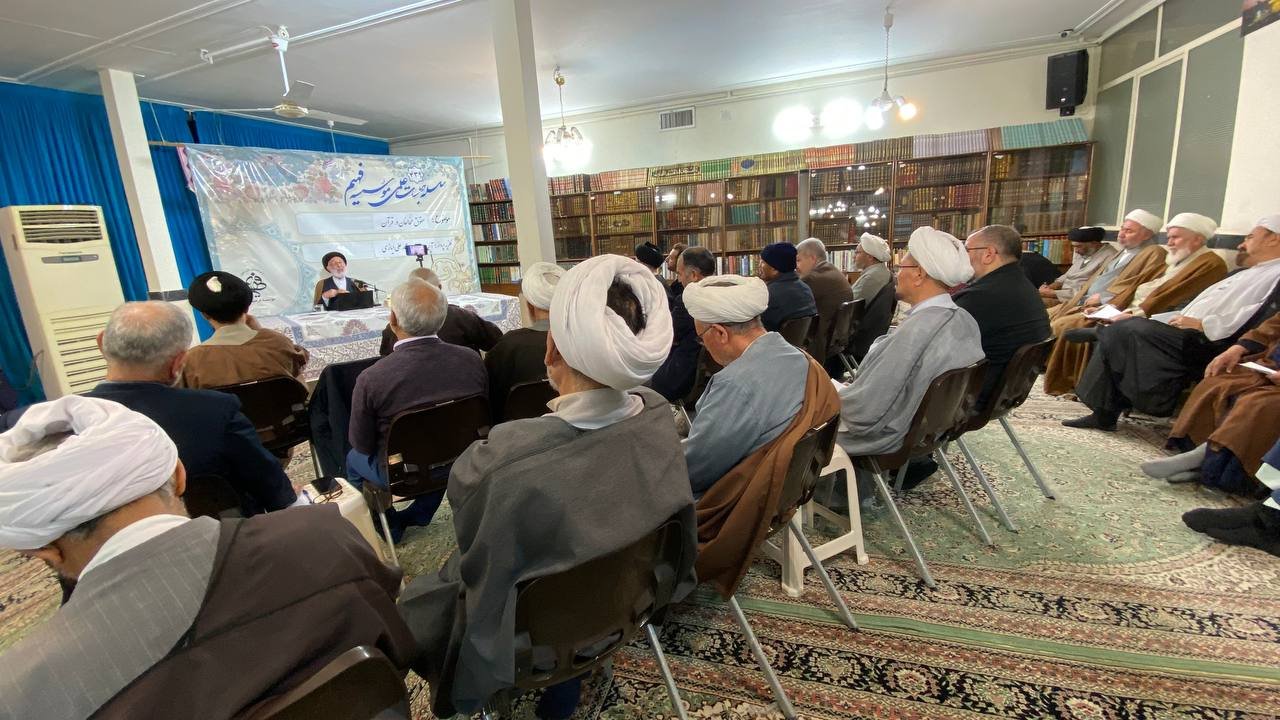
According to Andisheh-ye Ma, citing the Public Relations Office of the Fahim Cultural Research Institute, a colloquium of the professors and researchers of the Fahim Institute with Professor Mohammad Ali Elahi, Head of Dar al-Hikmah in Michigan, on the topic “The Challenges of Religiosity in the Contemporary World and the Ways Out of Them” was held in the Institute’s assembly hall in the city of Qom.
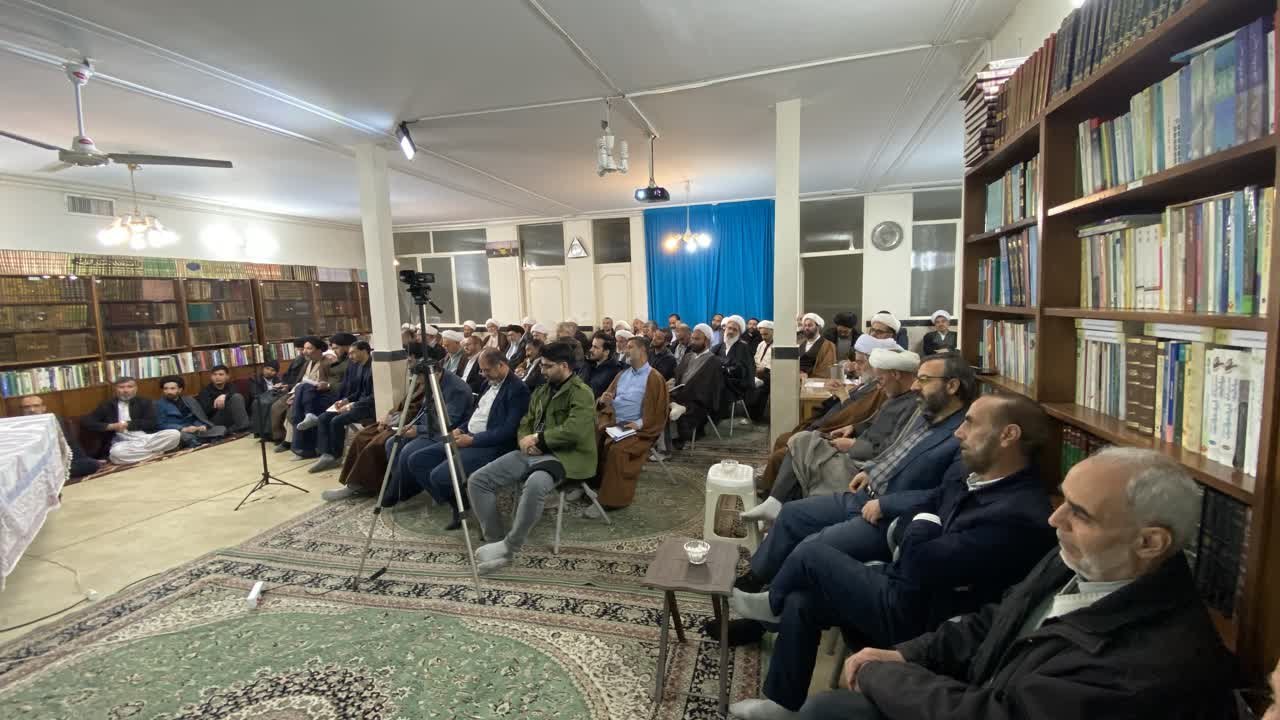
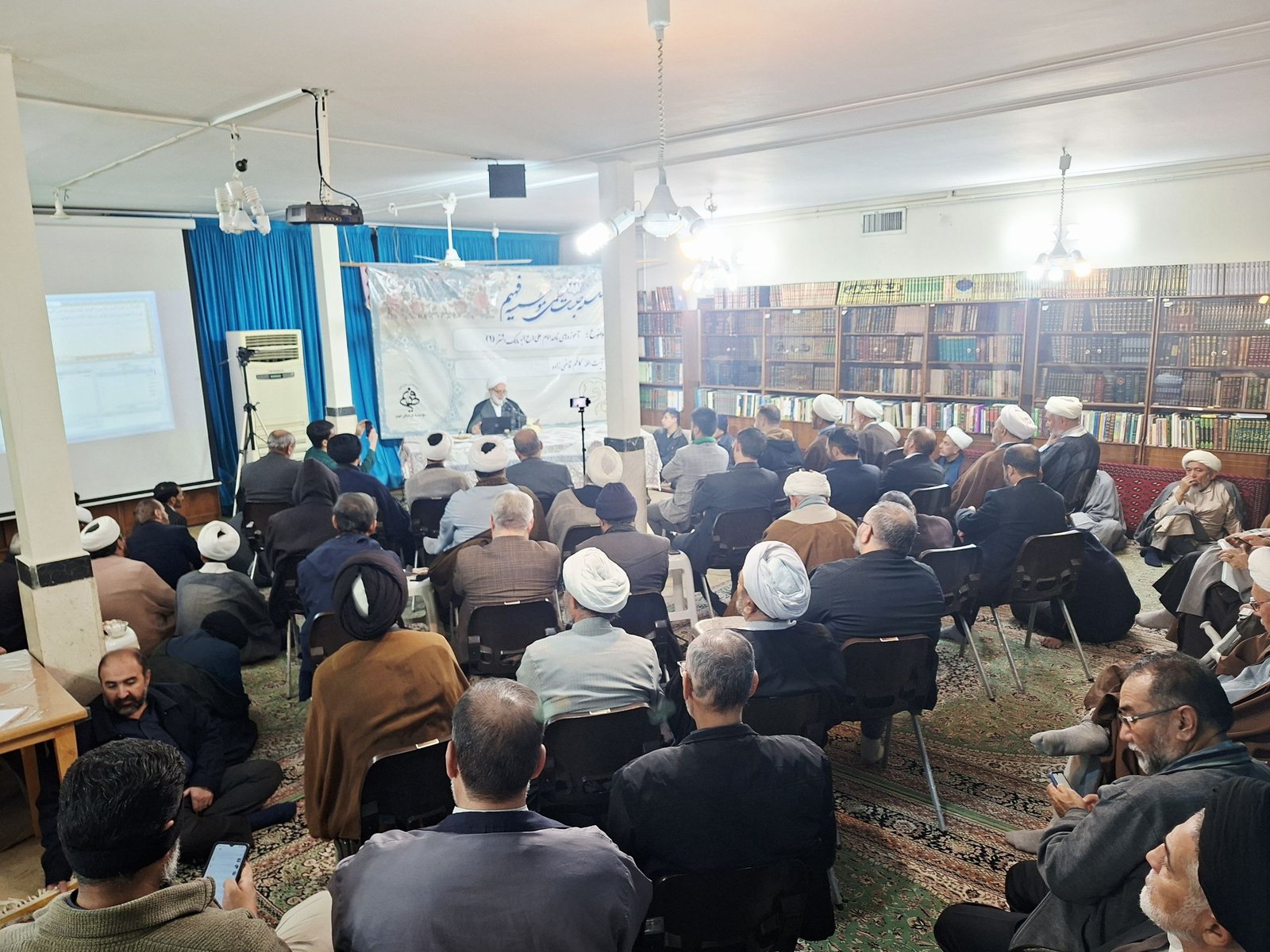
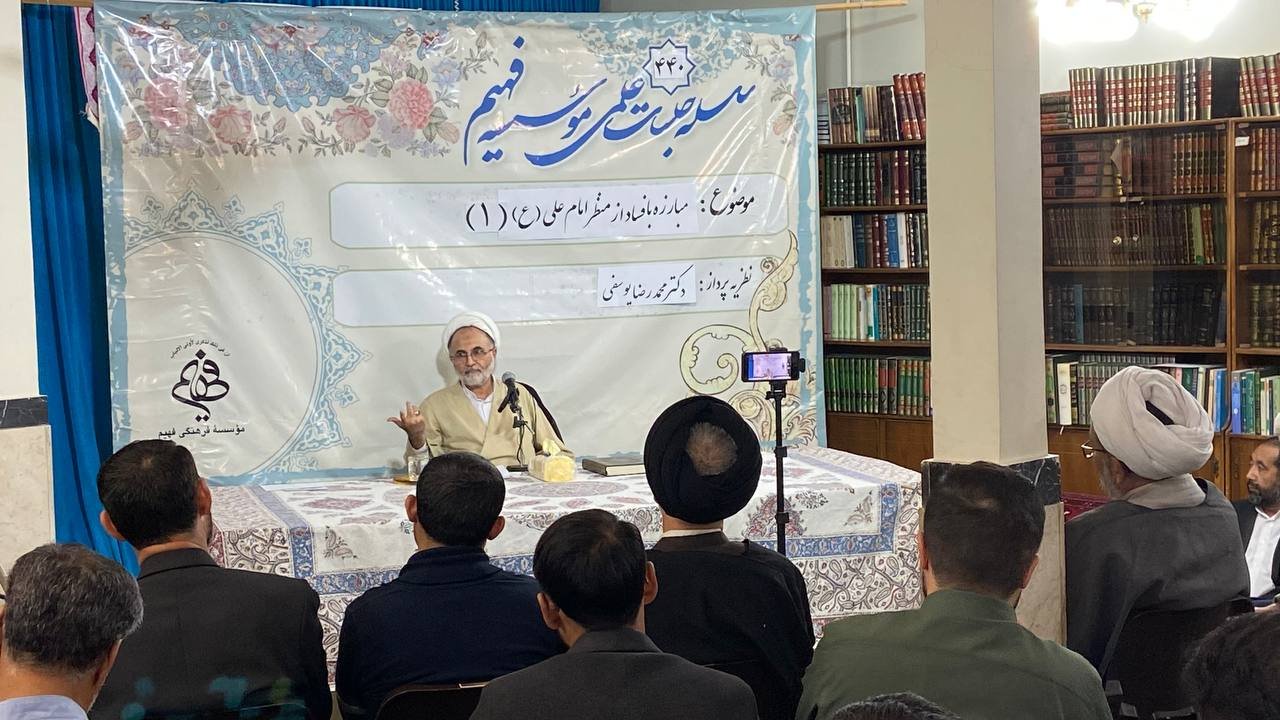
The session was convened on the evening of Wednesday, 29 Mehr 1404, at the premises of the Fahim Institute, with more than twenty professors and researchers in attendance. At the outset of the session, Ayatollah Qazizadeh, Head of the Fahim Institute, introduced those present and said: For the Fahim Institute, which enjoys extensive scholarly connections beyond the country’s borders and draws on the capacities of professors both inside and outside Iran, the presence of guests residing abroad is a valuable opportunity. We asked Dr. Elahi to join this gathering during his short trip to Iran.
We hope that this cordial session, held with a limited group of professors and scholars, will pave the way for the friends to become better acquainted with one another. Moreover, given Mr. Elahi’s residence in America and the challenges raised there concerning religiosity, we request him to open the discussion for a few minutes, so that the other professors, as the time of the session allows, may benefit from his remarks and discuss them.
The topic we have set for this session of about two hours, in which we shall benefit first from the remarks of Hajj Agha Elahi and then from the views of the other professors, is an examination of “the challenges of religiosity in the contemporary world and the ways out of them.” The reality is that, with the emergence of new arenas in technology, transformations in political relations and the formation of new cultural spaces, both virtual and non-virtual, one of the serious concerns of religious believers is that religiosity has come to face formidable challenges. It is no longer as it was in the past, when a father or mother could be confident that their children would continue along the family’s path of faith. Although in Iran political challenges and certain executive and governmental failures have fuelled the intensification of this trend, the phenomenon is not peculiar to Iran; those who are in Iraq or who live in European and Western countries report the same concern. We therefore considered it fitting to hear the professors’ views on an accurate portrayal of this crisis, on identifying its root causes and on seeking solutions for overcoming it. Sheikh Hadi Soroush had also been invited to this session but was unable to attend because he was preaching from the minbar in Tehran; he did, however, put forward some questions to be taken into account in the course of the discussion. Now, with the recitation of a salawat, we ask Hajj Agha Elahi to begin; although he jokingly remarks that if the friends speak first, the discussion might well be drawn into the conflict between Iran and America and the Trump affair! Nevertheless, we ask him to devote the first part of his remarks to the challenges of religiosity and the second part to the current political situation.
Hujjat al-Islam wal-Muslimin Dr. Mohammad Ali Elahi:
«بِسْمِ اللهِ الرَّحْمٰنِ الرَّحِیمِ، اَلْحَمْدُ لِلهِ رَبِّ الْعَالَمِینَ، وَالصَّلَاةُ وَالسَّلَامُ عَلَی رَسُولِهِ الْکَرِیمِ وَعَلَی آلِهِ الطَّیِّبِینَ الطَّاهِرِینَ». First of all, I sincerely thank Mr. Qazizadeh, who is always «دَالٌّ عَلَی الْخَیْرِ» (a guide to good) and a source of goodness and service, and I express my gratitude to the honoured masters and esteemed professors in this gathering. In the online group of the friends of Fahim, I always benefit from the learned notes of distinguished scholars such as His Eminence Ayatollah Mortazavi, Ayatollah Soroush Mahallati, Dr. Majid Moradi and other dear colleagues. Also present alongside us are Dr. Hejazi and Dr. Sayyed Mahmoud Mousavi, who over many years have gathered invaluable experience in the universities and Islamic and Christian centres of America and Canada; for twenty years, since the time Mr. Mousavi was in Florida, I have benefited from his exegetical discussions, and I have always benefited from Mr. Hejazi’s experience as well. Speaking in the presence of these eminent figures is therefore like carrying coals to Newcastle.
Regarding the topic that Mr. Qazizadeh raised, since I have been in the middle of a journey, I have not had the opportunity to turn to statistics and quantitative research; for in the West numerous statistical studies have been conducted on the phenomenon of religiosity and the turning away from religion, and at present I can only offer the professors my own direct observations and experiences. When I was about to fly to Istanbul on Turkish Airlines from Detroit airport, just as I was boarding the plane, the US State Department issued a very severe security warning. Such warnings had, of course, been issued before over the past year or two, but this new message had a far more serious tone, stressing that one should under no circumstances travel to Iran and that anyone in Iran should leave the country immediately; a warning whose scope had been extended to the entire Middle East region a day or two earlier.
I thought to myself that wartime conditions and the dangers surrounding Iran are nothing new; «تَوَکَّلْنَا عَلَی اللهِ». Is our life dearer than the lives of the martyred Leader, or Sayyed Hassan Nasrallah and the other martyrs on the path of truth, that we should refrain from travelling to our homeland for fear of danger? Now that seventy years of our life have passed and we have seen the east and west, north and south of this world, if we live a few more years, what astonishing new event could possibly happen in this world whose loss would be a cause of regret and loss?
Since I follow political developments and the news constantly, and on my mobile phone I am a member of a WhatsApp news network based in Lebanon that every few minutes relays news of artillery attacks, missile launches and developments in America and the region, my wife repeatedly tells me to put this phone aside; we cannot stop the course of world events, and this constant following only torments your nerves and mind. Truly, sometimes a person reaches such a point from the severity of afflictions that, in these days of Fatimiyyah, he murmurs the supplication of Lady al-Zahra (SA), who said: «اَللّٰهُمَّ عَجِّلْ وَفَاتِی سَرِیعاً». Wishing for death is, of course, disliked (makruh) in the Shari'ah, unless it takes the form of yearning for martyrdom; but the truth is that continuing to live and enduring the hardship of life is worthwhile only when one can render some service to others; otherwise death is a moment of ease and rest for a human being.
At the same time, from another perspective, beholding this scene is a source of pride and honour. Observe how Saudi Arabia, alongside America, Israel, the European countries, Turkey, Pakistan, Egypt and the takfiris of Syria, joined hands, yet were left helpless before a besieged and seemingly barefoot people in Yemen. Iran’s situation too has displayed such glory and dignity on the global stage. In America itself, thinkers, journalists and university professors such as Tucker Carlson, Jeffrey Sachs and dozens of other figures offer in-depth analyses of Iran day and night and have launched a great awakening movement against the crimes of Israel and the injustice prevailing in the world. When one places these facts beside those airport warnings, one realises that today is the arena of confrontation between «honour and humiliation» and a clear instance of «هَیْهَاتَ مِنَّا الذِّلَّةُ».
With this same inner calm I entered the jet bridge to the plane, when suddenly I saw several police officers standing there. One of them called me over and asked how much cash I was carrying. Under American law, a traveller leaving the country is not permitted to carry more than ten thousand dollars in cash, and, knowing this law, we always carry a smaller amount so that there is no legal pretext whatsoever. I told the officer that the amount I had with me was less than the ceiling he had in mind. He insisted that I write the exact amount on a form and sign it; for under American law, if someone tells a federal officer something untrue, that in itself is considered a serious crime, and they wanted to have a document for court. Strangely, among all those passengers they came to me, opened my hand luggage and emptied out all its contents piece by piece to count the banknotes. They even pulled out a small amount of Turkish lira and Iranian banknotes that had remained in my bag from previous trips, in order to calculate their exchange value in dollars and see whether their total exceeded the legal ceiling! Nevertheless, since I had been prepared in advance for such treatment, I went through the scene with complete calm.
This incident is itself a tangible example of the challenges of religiosity and of being a Muslim in the West. Even if you are an official citizen of America, the mere fact of being a Muslim and of Middle Eastern origin exposes you to racism and Islamophobia; a phenomenon that has doubled in intensity during the presidency of this lying and corrupt individual. Interestingly, perhaps close to seventy percent of American society know that Trump is a corrupt, deceitful, greedy and profit-driven person, and that even his warmongering is a kind of business for himself, his family and the oil and arms companies that backed him in the election; yet, for all that, when he speaks about the events and protests in France, he explicitly claims that this crisis has nothing to do with educational and social issues, but that the main problem is Islam itself, and he tells the Europeans: we warned you to stop Muslim immigration, otherwise Paris would become an Islamic city!
The extent of this Islamophobia has become far more visible in the state of Michigan, where we live, on the eve of the upcoming elections. A young man named “Abdulrahman El-Sayed,” born in America to a family of Egyptian descent and whose father’s name is Mohamed, has become a candidate for the US Senate. In his harsh and direct attacks, Trump deliberately calls him “Mohammed Abdul-Sayed” in order to stir up anti-Islamic sentiment by highlighting the name Mohammed. If he wins, he will be the first Muslim senator in the history of the US Senate; although in the House of Representatives there are one or two Muslim figures, such as Ilhan Omar from Somalia and Rashida Tlaib from Palestine, who have also been subjected to the most intense pressure and even searches of their homes. The Zionist lobby “AIPAC” in Washington spent around fifty million dollars to ensure the victory of his pro-Israel female rival in the Democratic primary in Michigan and to prevent Abdulrahman from reaching the final stage; but despite that exorbitant expenditure, Abdulrahman won, and he now faces the Republican candidate in the November election. Because this young man had attended and spoken at the Ashura ceremonies and the Friday prayer of our Islamic centre at Dar al-Hikmah, they have brought heavy pressure to bear on us and are trying, on the pretext of an election candidate entering a religious gathering, to revoke our centre’s non-profit licence; whereas we have officially announced that the doors of our centre are open to the candidates of both parties to engage in dialogue with the people.
Sensitivity and hostility towards the manifestations of Islam have risen to such a degree that the governor of Texas has ordered the ablution (wudu) facility at the Texas international airport to be closed, on the pretext that the existence of an ablution facility signifies the infiltration of “Shari'ah law” and the granting of special privileges to Muslims! This is while airports have shared prayer rooms and places of worship for followers of various religions, and it is natural that Muslims need to perform ablution for prayer, not that they have demanded a special privilege. Likewise, regarding the city of “Dearborn,” the centre of our activities, right-wing media propagate that it is the capital of jihadists; whereas in this very city dozens of liquor stores operate, and if Shari'ah law governed the city, such establishments would not exist. Of course, since the immigration of Muslims, especially devout Shi'is from South Lebanon and Iraq, to Michigan has a hundred-year history, and the Shi'i community there enjoys considerable social, judicial, academic and economic weight, to the extent that Michigan is called “the Qom of America,” and the mayors of both Dearborn and Dearborn Heights, and even the city’s police chief, are Shi'is of Lebanese descent, our position is far more secure than elsewhere. Nevertheless, we too are not safe from the harm of Islamophobia; for instance, a person seeking attention and votes in the state of Florida flies for hours to Dearborn to burn the Holy Qur’an in front of the Islamic centre and regards this as a sign of courage and freedom of speech! By contrast, if someone utters the slightest word in criticism of Jews or Zionism, or insults a synagogue, he is immediately subjected to severe legal prosecution on charges of “anti-Semitism” and Judeophobia; yet insulting Islamic sanctities is regarded as legitimate and praiseworthy under the constitutional principle of “freedom of speech and expression of opinion.”
Of course, in comparing the two ruling parties in America, as Mr. Soroush also pointed out in one of his notes, there is no essential difference between Democrats and Republicans in America’s overarching strategic interests and its hostility towards Iran, although their methods differ; thus the JCPOA agreement was signed under Obama and Trump tore it up. In domestic policy too, Democrats, because they rely on the votes of minorities and immigrants, provide a better atmosphere for Muslims, whereas the Republicans, and especially Trump himself, from the very event of September 11 claimed with blatant falsehood that he had seen with his own eyes Muslims dancing as the towers collapsed; a claim for which there is no document or image whatsoever, but which his fanatical followers accept.
For all that, at the present juncture the war against Iran has become the most unpopular war in the whole of American history and has sharply reduced Trump’s popularity; even in comparison with the wars of Vietnam, Afghanistan and Iraq, the percentage of American society opposed to this war is unprecedented. One of the tangible factors in this discontent is the surge in the price of gasoline and diesel; such that the price of a gallon of diesel has risen from about two dollars to nearly seven dollars, and even higher in a state like California, placing a heavy burden on the agricultural sector and on people’s daily lives. For this reason, Trump has serious doubts about continuing or resuming the war, although, on the other hand, the pressure of Netanyahu, the Zionist lobby and the wealthy Jewish families who helped him with up to one hundred million dollars in the election campaign is pushing him towards adventurism.
As for the phenomenon of turning away from religion in American society itself, it must be said that the decline of attachment to the church among the new generation is entirely evident; to the point that many of our present mosques in Michigan, including the current building of “Dar al-Hikmah,” were formerly churches that were closed and sold for lack of congregants. Alongside the closure of traditional Catholic and Protestant churches, however, two currents continue to attract large audiences: one is the huge, modern churches that hold their Sunday services with music, dancing and noisy concerts and gather thousands of young people for entertainment; the other is the current of Zionist and evangelical Christianity, known as the “Evangelicals,” who, by promoting apocalyptic beliefs and with massive financial backing, have become a political base for fanatical support of Israel and of Trump himself; to the extent that their pastors form a circle around Trump and sanctify him as a saviour and messiah.
In a broad analysis of the causes of turning away from religion in the contemporary world, numerous factors can be enumerated. Part of the new generation, on the basis of the notion of a conflict between science and religion, imagine that with the advance of empirical science there is no longer any need for the institution of religion. Another part regard religiosity as an obstacle to worldly gratification. In the West, another very important factor has been the moral corruption and sexual scandals of Catholic priests in the abuse of children attending church Sunday classes, which led to widespread lawsuits and the payment of billions of dollars in compensation and produced public revulsion towards the institution of the church. Alongside these, economic hardship and poverty are not without effect in spiritual and religious crises. Contrary to the notion held by some in Iran who imagine that dollars are strewn on the streets of America, poverty is rampant there; every day on my way from home to the mosque I see beggars who, in sub-zero cold, get into physical fights with one another over a suitable spot under the bridges. Tens of millions of people in America have no health insurance, and in the vicinity of Detroit itself numerous families have had their household drinking water cut off for years because they were unable to pay their bills. The combination of these material pressures with spiritual emptiness and social despair has led to the spread of depression; such that in the last calendar year alone, forty-nine thousand people in America died by suicide. At the end of this part of his remarks, he stressed that today in the West, hostility towards Islam has become intertwined with hostility towards Shi'ism and Iranophobia, and has even led to armed attacks and arson at mosques and the martyrdom of worshippers, and that getting through these conditions requires the prayers of the eminent figures of the hawza.
Dr. Majid Moradi: Noting that he had been in Van the previous night and in Rasht at noon, and that despite the fatigue of travel he had now made his way to this blessed gathering, he raised several points. Confirming the existence of poverty in America, he pointed out that, from another perspective, the scale of the massive dollar embezzlements and windfall fortunes amassed by certain individuals in Iran is not seen anywhere else. As an example, he referred to a recollection of “Warren Christopher,” the former US Secretary of State who taught at a university after his term in office, showing how even an amount of twenty dollars had real value and was strictly accounted for in their economic system, whereas in Iran, until a few years ago, a twenty-thousand-toman banknote was considered worthless, while at the same time astronomical sums of thousands of billions of tomans and several billion dollars were being moved around in financial corruption cases. Dr. Moradi also, referring to a recollection, discussed the differences in people’s mental and cultural standards, and then turned to a sociological analysis of the decline in religious inclinations.
In Dr. Moradi’s view, a large part of what was seen in the past as people’s “religiosity” stemmed from the social, recreational and entertaining functions of religious rites. Religion and its rites were not confined to purely devotional aspects, but gave meaning, vitality and entertainment to people’s daily lives. Today, in the modern world, large shopping centres and “malls” have taken the place of religious institutions in filling leisure time and giving meaning to daily life, while our religious custodians still wish to face society with the traditional forms of the past. At the end of his remarks he recalled that some twenty-five years ago, while translating the book “Al-Hayat” by the late Allamah Mohammad Hussein Fadlallah, he came across the topic of “dancing,” on which the author had avoided giving an explicit answer, but later he stated explicitly that the requirements of the Islamic movement might necessitate a revision of earlier jurisprudential rulings on such matters; just as a few nights ago, in a conversation with Professor Mahdavi-Rad, the point was raised that the proofs for the absolute prohibition of dancing do not have complete jurisprudential probative force.
Then Hujjat al-Islam wal-Muslimin Mehdi Pourhossein raised a question: during Trump’s second-term presidential election, media reports indicated that the majority of the Muslim community in Michigan leaned towards Trump and voted for him; do these reports correspond to reality?
Dr. Elahi explained in reply that the Gaza catastrophe completely destroyed the standing of Biden and the Democrats among Muslims. Although, after Biden’s withdrawal, Kamala Harris tried to convince Muslims that Trump’s coming would make the situation far worse, the deep anger of the Islamic community at the genocide in Gaza prevented this message from being heard. On the other hand, Trump deceitfully called himself the “president of peace,” and Muslims weary of war, in keeping with the well-known proverb «اَلْغَرِیقُ یتشبث بِکُلِّ حَشِیشٍ», pinned their hopes on those false promises. In addition, some traditional Muslims and even a number of turbaned clerics leaned towards Trump because of the Republican Party’s conservative positions in opposing abortion and homosexuality; unaware that the leaders of that party adhere to no moral principle in their personal lives and that these slogans are merely a political tool. How astonishing that one can show such sensitivity to the abortion of a single foetus and put up protest placards in front of churches, yet remain silent in the face of the genocide and killing of two to three hundred thousand innocent human beings in Gaza! The emotional atmosphere of those days was so heavy that if, in the Friday prayer sermons, I uttered a word criticising this naivety or in relative defence of the Democrats, some worshippers would become upset; although today everyone has realised what a great deception they fell for.
Next, Hujjat al-Islam wal-Muslimin Taqavi asked: beyond the domain of the Shari'ah and political conflicts, at the levels of belief, ethics and inner spirituality, what is the state of attachment to religion among Christian society and also among the new generation of Shi'is and Muslims in America? In particular, given the moral positions of the Pope and the challenge the Catholic Church has posed to Trump’s policies, what place do the spiritual messages of religion have in that society?
Then Ayatollah Soroush Mahallati, noting that this gathering is a seminarian circle in the heart of the Hawza of Qom, asked Dr. Elahi what specific expectation he, as a Shi'i scholar residing in the West, and the Shi'i community of America have of the Hawza of Qom, and what gap they feel that the hawza must take steps to fill.
After that, Hujjat al-Islam wal-Muslimin Sayyed Mahmoud Mousavi Shahroudi in brief remarks referred to the role of Western media propaganda in exaggerating Iran’s shortcomings and said: despite all the economic hardships and heavy inflation with which we struggle daily, we should not, under the influence of the insinuations of foreigners, imagine that our situation is unparalleled in the world and a dead end. He referred to a recollection from his period of residence in Africa, of how the country of Zimbabwe, without being involved in war or forty-seven years of sanctions, merely because of the government’s decision to dispossess white and British landowners, suffered within a short time such a monetary collapse that the value of one US dollar went from seven Zimbabwean dollars to millions and billions of dollars, to the point that the country’s national currency lost all credibility. Likewise in Lebanon a few years ago, without any war at that juncture, people’s dollar deposits in official banks suddenly vanished; something that, despite all the constraints, has not happened in Iran. He added that even in comparison with the massive financial corruption of Trump’s associates in America, the achievements and resilience of a country that has been under economic siege for nearly half a century should not be overlooked. Meanwhile, Ayatollah Mortazavi and some of those present noted that the Zimbabwe crisis resulted from the confiscation of people’s property and that comparing it with Iran’s conditions is open to question.
Then Hujjat al-Islam wal-Muslimin Sayyed Sadegh Ghaderi pointed to an apparent contradiction in Dr. Elahi’s account and said: on the one hand you speak of a heavy atmosphere of hostility to Islam and body searches at the airport, and on the other you report that in your city two mayors and the police chief are Shi'is, a young Muslim becomes a candidate for the US Senate, and in a metropolis such as New York a Muslim also attains the office of mayor. Does this not mean that the political structure of the West is not at war with religion as such, but only opposes extremist, radical and ISIS-like readings of religion; just as we too in Qom and Iran are at odds with domestic radical and extremist currents? How can this political openness to the advancement of Muslims be reconciled with that alleged hostility to Islam?
Next, Dr. Hamid Reza Shariatmadari focused his question on the current political and military conflict between Iran and America and enquired to what extent America’s domestic and electoral developments are effective in restraining war and in deterrence, and how, from the perspective of observers inside America, the future of this military confrontation is analysed.
Hujjat al-Islam wal-Muslimin Sayyed Abolfazl Mousavian also pointed out briefly that there is an essential difference between turning away from religion in the West and in Iran; for in Iran, a significant part of the young generation’s turning away from religion is a reaction to the performance of the “religious government” and its inability to solve chronic and debilitating problems, especially the continuous inflation of fifty to one hundred percent over many years, which has exhausted people’s endurance and is being laid at the door of religion.
The last speaker among the professors was Ayatollah Sayyed Mohammad Ali Ayazi, who stated that he had prepared a detailed note to examine the challenges of religiosity, apart from political aspects, from a scholarly and sociological perspective and on the basis of global field research. He stressed that religion has various doctrinal, social and ethical dimensions, and that our traditional way of dealing with it, whereby we previously feared the free raising of doubts and tried to prevent questions from being raised through restrictions, has itself caused greater harm. Professor Ayazi promised to send the full text of his note and his strategic proposals for the professors’ use.
In the final part of the session, Hujjat al-Islam wal-Muslimin Dr. Elahi, in reply to the question about the Pope’s position, stated that the Pope, in a fair and courageous stance, declared the war against Iran unjust and contrary to international law, but immediately became the target of harsh attacks by the American government; to the point that “JD Vance,” the Vice President, who has himself recently converted to Catholicism, brazenly attacked the Pope, saying he had better attend to his own church affairs and leave politics to politicians! After that, “Marco Rubio” went to Rome to put pressure on the Vatican and force the Pope into silence, a silence to which, unfortunately, the Pope’s cancer also contributed. In Michigan I discussed this matter with the Catholic archbishop, with whom we have a friendly relationship and who had invited us to his home; in private circles they fully endorse the Pope’s position and consider the war unjust, but for fear of political pressure they are not prepared to bring this subject into the Sunday sermons of the churches.
In reply to Ayatollah Soroush Mahallati’s question about expectations of the Hawza of Qom, Dr. Elahi referred to the concrete example of his own son, Dr. Mahdi, an intelligent young pharmacist in America who recently, despite being married, having bought a home and holding an excellent professional position, left it all behind and came to Qom this very week and spoke with the officials of Al-Mustafa International University in order to pursue religious studies. He added: We know that the Hawza of Qom does not enjoy the vast financial resources that the Saudi government spends on training and dispatching takfiri preachers; but the least expectation is that when an elite, educated young person comes to Qom from America or Europe with a divine motive, they should not entangle him in political games, factional narrow-mindedness and security suspicions, but should welcome him with open arms and train a first-rate preacher for the Western world.
He went on, confirming Mr. Mousavi’s remarks on the extent of corruption in the world as an instance of the noble verse «ظَهَرَ الْفَسَادُ فِی الْبَرِّ وَالْبَحْرِ», to refer to the fabulous fortunes and rents of hundreds of billions of dollars of individuals such as Elon Musk in America, and added: the very Zionist centres that spend money in America to promote Islamophobia also finance networks such as “Iran International,” so that a number of unemployed and needy expatriate journalists may brainwash Iranian society day and night through fabrication and the exaggeration of problems. The result of this propaganda bombardment is that the uncommon integrity and honesty of a figure such as Dr. Pezeshkian in the presidency goes unseen, and Iran’s remarkable scientific, medical and defence progress since the Revolution—compared with the pre-revolutionary era, when we needed Indian and Pakistani doctors to treat simple illnesses—is overlooked. He also announced the imminent publication of his memoirs in English under the title “A Journey on the Path of Faith,” which contains historical photographs of him alongside His Eminence Imam Khomeini, the martyred Leader Ayatollah Khamenei at the first Friday prayer of Tehran, the late Ayatollah Hashemi Rafsanjani, as well as last year’s meeting with Dr. Pezeshkian in New York.
In reply to Mr. Ghaderi’s ambiguity, Dr. Elahi stated explicitly that the election of Muslim mayors in cities such as Dearborn is the product of the Muslim demographic majority and of the legal frameworks of local elections, which the federal government has no power to annul; otherwise, wherever they can, they mobilise with all their might to eliminate Muslim figures such as “Zohran Mamdani” in New York. In reply to a brief question as to why Mamdani, despite being a Shi'i, sometimes prays in mosques with folded arms in the manner of the Sunnis, he said that although there is no necessity for this, he is a very intelligent person and, because he attends mosques with a Sunni majority, does so for the sake of preserving unity.
Finally, in reply to Mr. Shariatmadari’s question about the outlook of the war, referring to the security and economic instability of the Arab countries of the Persian Gulf littoral—where one must now pay exorbitant sums to find a flight in Saudi Arabia or flee overland to Qatar and Bahrain—he praised the security and stability of the market inside Iran; such that, contrary to the impressions created by the media’s psychological warfare, which led us to think there was a bread famine in Iran, an abundance of goods is to be seen in the Tehran bazaar. At the same time, he related that on that same day, in a meeting with Mr. Khatami, the latter had considered a military attack to be certain; for Netanyahu is wholeheartedly seeking the overthrow of the system and the imposition of war, although Trump’s electoral considerations constitute an obstacle to it. Dr. Elahi expressed the hope that, by divine grace, and just as divine miracles have aided this nation since the beginning of the Islamic Revolution, dear Iran will pass safely through this perilous pass as well and serve humanity.
At the close of this scholarly gathering, Dr. Hejazi, in honour of the presence of Dr. Elahi, who had come to Qom from a distance of twelve thousand kilometres and who, in the land of the West, transformed a church into the Islamic centre “Dar al-Hikmah” and placed the crescent of Islam and the Divine Name “Allah” atop it, recited as a spiritual gift the special salawat for His Holiness the Master of the Age (AJ), attributed to the Muhaqqiq al-Tusi, Khwaja Nasir al-Din—whose noble tomb lies near Kadhimiya—and those present rose to their feet upon hearing the blessed name of the Imam of the Age:
«اَللّٰهُمَّ صَلِّ وَسَلِّمْ عَلَی صَاحِبِ الدَّعْوَةِ النَّبَوِیَّةِ، وَالصَّوْلَةِ الْحَیْدَرِیَّةِ، وَالْعِصْمَةِ الْفَاطِمِیَّةِ، وَالْحِلْمِ الْحَسَنِیَّةِ، وَالشُّجَاعَةِ الْحُسَیْنِیَّةِ، وَالْعِبَادَةِ السَّجَّادِیَّةِ، وَالْمَآثِرِ الْبَاقِرِیَّةِ، وَالْآثَارِ الْجَعْفَرِیَّةِ، وَالْعُلُومِ الْکَاظِمِیَّةِ، وَالْحُجَجِ الرَّضَوِیَّةِ، وَالْجُودِ التَّقَوِیَّةِ، وَالنَّقَاوَةِ النَّقَوِیَّةِ، وَالْهَیْبَةِ الْعَسْکَرِیَّةِ، وَالْغَیْبَةِ الْإِلٰهِیَّةِ».
Finally, Ayatollah Kazem Qazizadeh once again sincerely thanked all the professors and scholars for their presence, especially the honoured guest of the session, Dr. Elahi, who during the short time of his trip to Iran devoted his time to meeting with the friends, and before dinner was served, handed the floor to Mr. Sayyed Mahmoud Mousavi to relate a brief recollection.
Comments
No comments yet. Be the first.
Write a note, critique or commentShare your view with us and other readers without leaving this page.